Author: williamwhite

  • 10 Secure Email Communication Best Practices for 2025

    10 Secure Email Communication Best Practices for 2025

    In an environment where data breaches are common and invasive tracking is the norm, standard email has become a significant liability. Your inbox, once a simple communication tool, is now a primary target for sophisticated phishing attacks, intrusive advertising, and relentless data mining. Treating it with a casual, outdated approach is no longer a viable option. Effective and professional correspondence now depends entirely on a foundation of robust security and uncompromising privacy.

    This guide moves past generic advice to provide a comprehensive roundup of essential email communication best practices designed for the modern, privacy-conscious user. We will provide actionable steps that transform your email from a point of vulnerability into a secure, efficient, and reliable asset. The focus is squarely on practical implementation, covering everything from foundational security protocols like SPF and DKIM to advanced strategies for inbox organization and user management within a secure ecosystem.

    You will learn how to leverage hosted email platforms to enforce strong privacy controls, enhance message deliverability to avoid spam filters, and master the art of secure, professional correspondence. For individuals and businesses committed to protecting their data, especially those using privacy-first services like Typewire, these practices are not just helpful tips. They represent a fundamental framework for building trustworthy, confidential, and effective communication channels. Each point in this listicle is crafted to be immediately applicable, helping you secure your digital conversations and reclaim control over your inbox.

    1. Master Hosted Email Platforms for Ultimate Control

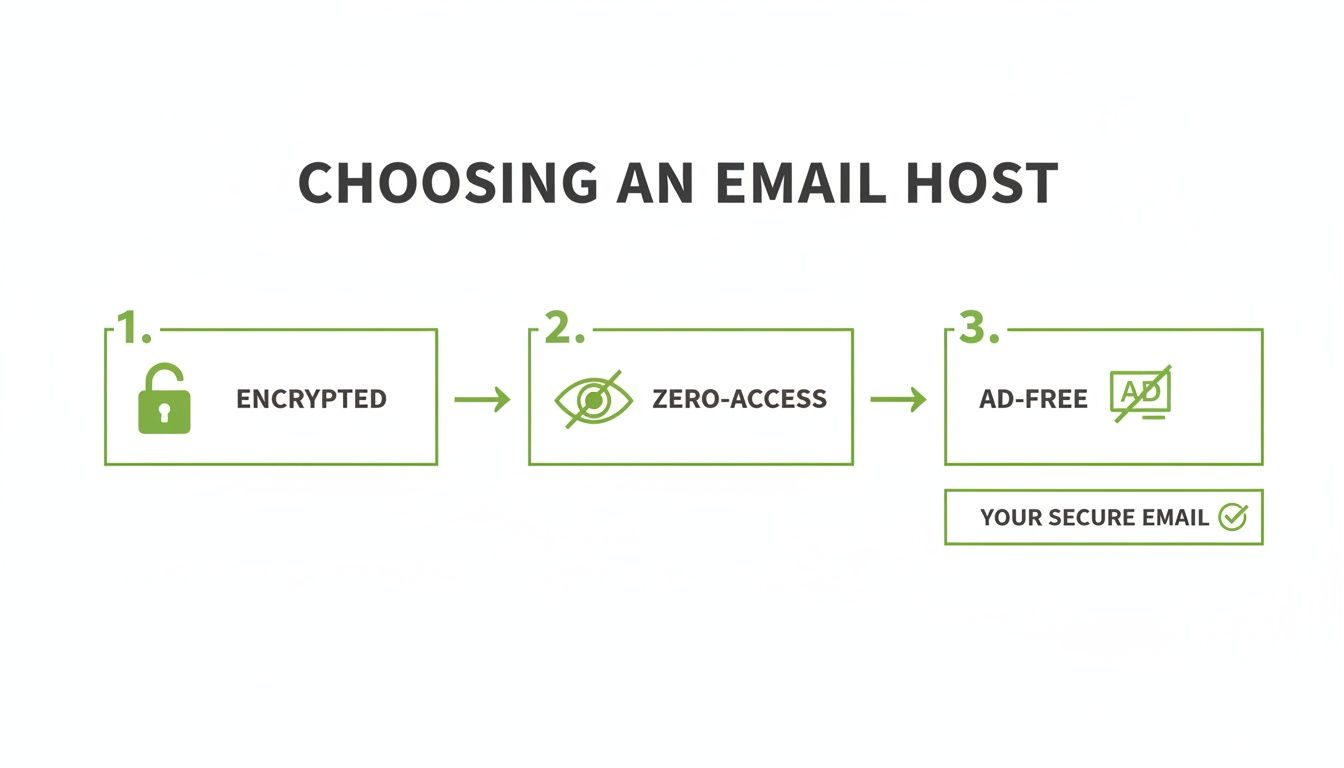
    The single most impactful step in establishing secure and private email communication best practices is moving away from free, ad-supported services. Choosing a premium hosted email platform places you in complete control of your data, establishing a secure foundation for all other privacy measures. Unlike free services that often treat your data as the product through tracking and ad-targeting, a hosted platform operates on private infrastructure dedicated to protecting your information.

    Why Hosted Email is Non-Negotiable for Privacy

    A hosted email solution means your communications are not scanned to build advertising profiles or sold to data brokers. This model is fundamentally aligned with user privacy. The provider’s business is to protect your data, not monetize it. This separation is critical for maintaining confidentiality and security, especially when handling sensitive information.

    For example, a law firm using a platform like Typewire can guarantee attorney-client privilege, as communications are stored on secure, private servers inaccessible to third parties. Similarly, a healthcare provider can manage patient correspondence in a HIPAA-compliant environment, a feat nearly impossible with standard free email accounts.

    Key Insight: With a hosted email platform, you are the customer, not the product. Your privacy is a feature you pay for, not a commodity to be traded.

    Actionable Steps for Implementation

    Making the switch to a hosted platform is straightforward. Follow these tips to ensure a successful transition and maximize your control:

    • Prioritize Full-Stack Providers: Select a provider that owns and operates its own hardware and data centers, like Typewire. This model eliminates the risks associated with third-party data handlers and gives you a single point of accountability for security.
    • Leverage User Management Tools: Once set up, use the platform's administrative controls to create custom roles and permissions for your team. This ensures that employees only access the information necessary for their jobs, minimizing internal data exposure.
    • Utilize Free Trials: Before committing, take advantage of trial periods to test the platform’s security features, user interface, and overall performance. Confirm it meets your specific workflow and compliance needs.
    • Confirm 24/7 Support: Ensure your chosen provider offers robust, around-the-clock support. Immediate access to expert help is crucial for resolving any potential security or deliverability issues.

    2. Personalize Email Content Without Sacrificing Privacy

    True personalization in email communication best practices goes far beyond a simple [First Name] merge tag. It involves creating a tailored experience by leveraging recipient-specific information, but it must be done within a secure, privacy-first framework. This dynamic approach transforms generic broadcasts into relevant, one-to-one conversations that build trust, all while respecting user privacy and avoiding invasive data collection.

    An iPad displaying a webpage with 'Beyond Names' and 'consgam' logo, showing various profile pictures.

    Why Advanced Personalization is a Privacy-First Strategy

    When executed responsibly, advanced personalization strengthens the user relationship because it is based on consent and delivered value. Unlike invasive tracking, this strategy relies on voluntarily provided or first-party engagement data to enhance the user experience, not exploit it for third-party advertising. The goal is to deliver content so relevant that it feels like a service, not a sales pitch, all within the secure confines of your hosted email platform.

    For example, a project management tool might send a user an email with tips specifically for a feature they frequently use, enhancing their workflow. A privacy-focused platform like Typewire could use onboarding data to send customized security checklists, helping new teams configure their accounts for maximum protection from day one. This level of detail demonstrates that you understand and respect the user’s needs without compromising their data.

    Key Insight: Meaningful personalization is a sign of respect for your audience's time and privacy. It proves you are listening and shifts your communication from being intrusive to being indispensable.

    Actionable Steps for Implementation

    Implementing advanced personalization requires a strategic approach that prioritizes data privacy and relevance. Follow these steps to create emails that resonate deeply with your audience:

    • Segment Audiences Meaningfully: Move beyond basic demographics. Create segments based on engagement levels (e.g., active users, inactive users), feature usage, or content preferences to send highly targeted messages.
    • Utilize Dynamic Content: Implement conditional content blocks within your emails. This allows you to show or hide specific sections based on a recipient's segment, so a single campaign can deliver multiple personalized versions.
    • Implement Progressive Profiling: Use forms to gradually collect more information over time instead of asking for everything at once. This builds a richer user profile in a non-intrusive way, respecting the user's comfort level.
    • Prioritize Consent and Transparency: Always be clear about what data you are collecting and how it will be used to personalize their experience. Provide easy-to-find opt-out options for all types of communication.

    3. Maintain Consistent Sending to Boost Sender Reputation

    Establishing a predictable sending schedule is a core component of effective email communication best practices, building trust with both your audience and email service providers. Irregular sending patterns, such as long periods of silence followed by a sudden burst of messages, can trigger spam filters and damage your sender reputation. A consistent cadence signals to inbox providers that you are a legitimate, reliable sender, which is crucial for email security and deliverability.

    Why Consistency Builds Trust and Deliverability

    A regular email schedule conditions your audience to expect your communications, reducing the likelihood of spam complaints. From a technical security perspective, email platforms like Typewire analyze sending volume and frequency to assess sender reputation. Consistency demonstrates responsible email behavior, preventing your messages from being flagged as suspicious or part of a potential spam attack. This is a key factor in passing through modern, AI-driven security filters.

    For example, a security-focused newsletter arriving at the same time each week builds a powerful reader habit and reinforces its legitimacy. This predictability helps email servers differentiate your planned communications from anomalous, potentially malicious activity, ensuring your important security updates or account notifications are not mistakenly filtered.

    Key Insight: Consistency is not just about marketing; it’s a security and deliverability signal. Predictable sending patterns are a hallmark of a trustworthy sender, reducing the risk of being flagged by spam filters.

    Actionable Steps for Implementation

    Creating a reliable schedule is a strategic process that enhances your security posture. Use these steps to build a consistent and effective sending rhythm:

    • Analyze Engagement Metrics: Dive into your email analytics to identify the days and times when your audience is most active. Use this data to establish a baseline for your sending schedule, optimizing for secure and reliable delivery.
    • Create an Editorial Calendar: Plan your content in advance. An editorial calendar removes the pressure of last-minute content creation and ensures a steady, predictable stream of communication that email servers recognize as legitimate.
    • Offer Frequency Preferences: Empower your subscribers by allowing them to choose how often they hear from you (e.g., daily, weekly, or monthly). This respects user preference and reduces the chance of spam complaints that harm your reputation.
    • Secure Your Foundation: Ensure your scheduling efforts are supported by robust security. For a comprehensive approach to securing your digital identities, refer to these credential management best practices for secure accounts.

    4. Implement Clear Call-to-Action (CTA) Buttons to Prevent Phishing

    Effective email communication guides the recipient toward a specific, safe action. Implementing prominent, unambiguous call-to-action (CTA) buttons is a critical component of secure email communication best practices. Clear CTAs provide a trusted, low-friction path for your audience, helping them distinguish legitimate requests from the deceptive links often found in phishing attacks.

    Close-up of a smartphone displaying an email with a 'Call To action' message on a wooden table.

    Why Clear CTAs Enhance Security

    In an era of sophisticated phishing, a well-designed CTA builds user confidence. When your emails consistently use a clear, branded button for primary actions, users learn to recognize it as a legitimate signal. This makes them less likely to click on rogue text links or suspicious attachments. A clear CTA removes ambiguity and trains recipients to look for trusted visual cues before acting, reinforcing secure online behavior.

    For example, a bank that always uses a distinct, blue 'Login to Your Account' button trains its customers to be wary of emails that use generic text links for the same action. This simple design consistency becomes a subtle but powerful security feature, helping users spot fraudulent attempts to steal their credentials.

    Key Insight: A call-to-action button is not just a link; it's a visual and psychological cue that directs user behavior and can be a key part of your anti-phishing strategy.

    Actionable Steps for Implementation

    Creating high-performing, secure CTAs involves a blend of design principles and strategic placement. Use these tips to craft buttons that get results:

    • Use First-Person Action Verbs: Frame the CTA from the user’s perspective to create a sense of ownership. Text like 'Access My Secure Portal' or 'Verify My Account' clearly communicates the action and intent.
    • Ensure Mobile Accessibility: Design buttons with a minimum height of 40-60 pixels to make them easy to tap on mobile devices. A frustrating mobile experience can lead users to seek alternative, less secure methods.
    • Prioritize Color Contrast: To meet accessibility standards and ensure visibility, aim for a color contrast ratio of at least 4.5:1 between the button and its background. Use a prominent, on-brand color that stands out.
    • Place CTAs Strategically: Position your primary CTA "above the fold" so it is visible without scrolling. Ensure the destination URL is clear and directs to your secure, HTTPS-enabled domain.

    5. Optimize Email Layout for a Secure Mobile Experience

    With over half of all emails now opened on mobile devices, optimizing your layout for smaller screens is a core tenet of secure email communication best practices. A mobile-first approach ensures your messages are readable and professional, but more importantly, it helps prevent user error that can lead to security risks. A poorly rendered email can cause users to misclick on malicious links or struggle to identify legitimate sender details.

    A person holds a smartphone displaying a webpage titled 'Mobile Optimized' with text, outdoors.

    Why Mobile-First Design is Crucial for Security

    A responsive email design automatically adapts its layout to fit the screen, ensuring a seamless and secure experience. When an email is difficult to read, users may rush through it, missing subtle signs of a phishing attempt. Clear, legible text and properly sized buttons reduce the chance of accidental clicks on malicious content disguised to look like legitimate links.

    For instance, a responsive design ensures that the sender's email address is fully visible, not truncated, allowing the recipient to verify its authenticity. For internal communications on a secure platform like Typewire, a responsive layout ensures that team members on the go can quickly read and act on important security alerts without the risk of misinterpretation caused by a broken layout.

    Key Insight: Mobile optimization is a security feature. A clean, responsive design reduces user error and makes it easier for recipients to identify and avoid phishing threats.

    Actionable Steps for Implementation

    Ensuring your emails are secure and readable on every device is a technical but achievable goal. Use these strategies to create a consistently safe viewing experience:

    • Adopt a Single-Column Layout: Use a single-column structure that stacks content vertically. This is the most reliable way to ensure readability and prevent elements from overlapping or becoming unclickable on narrow screens.
    • Utilize CSS Media Queries: Implement media queries in your email’s code to apply different styles based on screen width. This allows you to adjust font sizes and reformat layouts to maintain clarity on mobile devices.
    • Compress Images: Large image files can slow down loading times, especially on mobile data connections. Compress all images to ensure the email loads quickly and completely.
    • Test Extensively: Before sending, use tools to preview your email across dozens of mobile clients and devices. This helps you confirm that all links are correctly rendered and that there are no layout issues that could obscure important security information.

    6. Build and Maintain a Clean Email List for Security

    A core component of effective email communication best practices involves prioritizing list quality over quantity. Maintaining a clean email list is not just about deliverability; it's a security and privacy fundamental. A bloated list filled with inactive, invalid, or disengaged subscribers increases your risk profile, wastes resources, and damages your sender reputation, making it harder for your legitimate communications to reach their intended recipients.

    Why List Hygiene is a Security Imperative

    A clean, engaged email list is a direct reflection of a healthy sender reputation. Internet Service Providers (ISPs) and secure email platforms like Typewire analyze engagement metrics to filter spam and malicious content. High bounce rates from sending to non-existent addresses can signal that your system may be compromised and used for spamming. This hygiene practice ensures your critical communications are not mistakenly flagged as threats.

    For instance, a financial services firm sending quarterly statements must ensure its list is pristine. Removing hard bounces immediately prevents repeated attempts to send sensitive information to non-existent or compromised addresses, closing a potential security loophole. Regularly purging unengaged users also reduces the data footprint, minimizing the impact of a potential data breach.

    Key Insight: A clean email list is your first line of defense in protecting sender reputation. It tells receiving servers that you are a legitimate, responsible communicator, ensuring critical emails are delivered securely.

    Actionable Steps for Implementation

    Implementing a consistent list hygiene strategy is crucial for maintaining both deliverability and security. Follow these steps to build and maintain a high-quality email list:

    • Implement Double Opt-In: Require new subscribers to confirm their email address via a confirmation link. This validates every address from the start and prevents malicious bots from flooding your list with fake accounts.
    • Remove Hard Bounces Immediately: Configure your sending platform to automatically remove email addresses that result in a hard bounce (a permanent delivery failure). This is a critical signal to ISPs that you manage your list responsibly.
    • Create Re-Engagement Campaigns: For subscribers who have been inactive for a set period, such as 90 days, launch an automated re-engagement campaign. If they do not interact, remove them from your active sending list to reduce your attack surface.
    • Monitor Spam Complaint Rates: Pay close attention to your spam complaint rate. Immediately remove any user who marks your email as spam to prevent further damage to your domain’s reputation.

    7. Use Authentication Protocols (SPF, DKIM, DMARC)

    Implementing modern email authentication protocols is a non-negotiable step for establishing trust and security. Standards like SPF, DKIM, and DMARC are technical safeguards that verify a sender's identity, effectively preventing domain spoofing and phishing attacks. These protocols are the bedrock of secure email communication best practices, as they signal to receiving mail servers that your messages are legitimate and trustworthy.

    Why Authentication is Critical for Security and Deliverability

    Email authentication acts as a digital passport for your domain, confirming to providers like Gmail and Microsoft that messages sent from your address are authorized. Without these records, your emails can be easily impersonated by malicious actors who can send phishing emails from your domain. A strong DMARC policy tells receiving servers to reject such fraudulent emails, protecting your brand reputation and your customers.

    For instance, after implementing a strict DMARC policy, a financial services firm can prevent scammers from sending fraudulent invoices using its domain, protecting both its reputation and its clients. This is a foundational security measure for any organization. Learn more about how these protocols work together in our complete security guide to email authentication.

    Key Insight: Email authentication transforms your domain's reputation from a question mark into an undeniable statement of legitimacy, directly improving security and deliverability.

    Actionable Steps for Implementation

    Configuring these protocols involves adding specific DNS records for your domain. Here’s how to get started:

    • Start with an SPF Record: Create a TXT record in your DNS settings that lists all authorized mail servers for your domain. This tells receiving servers which IP addresses are permitted to send email on your behalf.
    • Implement DKIM Signing: Enable DKIM within your email provider’s settings, like Typewire. This adds a unique digital signature to your emails, which receiving servers can verify using a public key published in your DNS.
    • Deploy DMARC Gradually: Begin with a monitoring-only policy (p=none). This allows you to receive reports on who is sending email from your domain without affecting mail flow.
    • Enforce Your DMARC Policy: Once you confirm all legitimate mail is authenticated, move to a p=quarantine policy to send unverified emails to spam, and finally to p=reject to block them entirely.

    8. Segment Email Lists for Privacy and Relevance

    Sending generic, one-size-fits-all emails is one of the fastest ways to land in the spam folder. A core component of modern email communication best practices is segmentation—dividing subscribers into smaller groups. From a privacy perspective, this ensures you only send information relevant to a specific user group, adhering to the principle of data minimization and purpose limitation.

    Why Segmentation is Crucial for Privacy and Security

    Segmentation moves your email strategy from a broadcast to a secure, targeted conversation. Instead of sending sensitive information to your entire list, you can restrict it to only the relevant audience, reducing the risk of accidental data exposure. This targeted approach minimizes the likelihood of users marking your emails as spam, which is vital for maintaining a strong sender reputation.

    For example, a SaaS company using a secure platform like Typewire can segment its users by account type. An email containing a security update relevant only to enterprise customers can be sent exclusively to that segment, preventing unnecessary notifications and potential confusion for other users. This ensures every communication is valuable and respects the recipient's context, reinforcing trust.

    Key Insight: Segmentation is a privacy-enhancing tool. Sending relevant content reduces data exposure, builds trust, and protects your sender reputation.

    Actionable Steps for Implementation

    Implementing a powerful segmentation strategy is more accessible than it seems. Start with a few core groups and expand as you gather more data.

    • Define Foundational Segments: Begin by grouping your audience based on clear, consent-based criteria. Common starting points include new subscribers (for welcome series) or product usage levels (for feature updates).
    • Use Behavioral Triggers: Set up automated campaigns based on user actions within your application. Send a security tip to a user who just enabled a new feature. This real-time relevance is highly effective.
    • Combine Criteria for Micro-Targeting: Create granular segments by combining multiple data points. For instance, target "administrators of enterprise accounts" for a specific security policy update.
    • Regularly Clean Your Lists: Create a segment of inactive or unengaged subscribers. Send them a re-engagement campaign and remove those who don’t respond to keep your list healthy and minimize your data footprint.

    9. Create Valuable Content that Reinforces Security

    One of the most powerful email communication best practices involves shifting your focus from selling to serving, particularly by providing content that reinforces security and privacy awareness. Instead of sending purely promotional messages, you build trust by offering genuine value that also helps protect your users. This approach transforms your email into a welcome resource that strengthens your security posture.

    Why Value-Driven Content Enhances Security

    A value-first content strategy respects your subscribers' time and reinforces your commitment to their privacy and security. When your audience expects helpful security tips or privacy updates, they are more likely to engage with your messages and trust your brand. This positive engagement improves your sender reputation and ensures critical communications reliably reach the inbox.

    For instance, a cybersecurity firm could send a weekly digest of emerging threats and protection tips, establishing itself as a trusted authority. Similarly, a hosted email provider like Typewire can educate users on enabling two-factor authentication or recognizing phishing attempts. This content model provides tangible value while actively contributing to a more secure ecosystem for your users.

    Key Insight: Treat your subscribers' inbox as a privileged space. Earning your place there requires consistently delivering content that solves their problems, educates them, and helps keep them safe.

    Actionable Steps for Implementation

    Creating valuable, security-focused content is a systematic process. Use these tips to build a content strategy that serves your audience and strengthens your brand:

    • Follow the 80/20 Rule: Dedicate 80% of your content to providing value—security education, privacy insights, or best practice guides—and reserve only 20% for direct promotional messages.
    • Share Original Security Insights: Develop and distribute unique content like case studies on resolved security incidents (anonymized) or data-driven analyses of phishing trends.
    • Tell Authentic Stories: Share lessons learned about security challenges and successes. Authentic storytelling builds a human connection and makes your security advice more relatable.
    • Create Educational Content: Develop an email series that teaches users how to use your platform's security features. To streamline your messaging, explore these effective business email templates to structure your communications clearly.

    10. Monitor Key Email Metrics and Continuously Test

    To master a secure communication strategy, you must analyze performance. Monitoring key metrics and continuously testing different elements are essential email communication best practices that transform guesswork into a data-driven process. This allows you to systematically improve engagement and deliverability without compromising user privacy.

    Why Data-Driven Optimization is a Privacy-Conscious Approach

    A data-driven approach ensures your communication efforts are not wasted. By tracking metrics like open rates, click-through rates, and bounce rates within your own platform, you gain direct insight into audience behavior without sharing data with third-party trackers. Unlike ad-based platforms that track users across the web, your internal analytics focus solely on improving communication effectiveness within your secure environment.

    For instance, A/B testing a subject line about a new security feature can reveal which wording encourages more users to adopt it. Analyzing bounce rates can help you identify list hygiene issues before they damage your sender reputation. A hosted platform like Typewire provides these analytics in a private environment, ensuring your optimization efforts do not come at the cost of user privacy.

    Key Insight: Data-driven testing provides empirical evidence of what works. It replaces assumptions with facts, allowing you to optimize every element of your email for maximum impact and security.

    Actionable Steps for Implementation

    Implementing a testing framework is a powerful way to enhance your email strategy. Use these steps to build a continuous improvement cycle:

    • Isolate a Single Variable: To get clear results, test only one element at a time (A/B testing). For example, test two different subject lines while keeping the email body and send time identical.
    • Ensure Statistical Significance: Test with a large enough sample size to ensure your results are reliable. Most secure email platforms can help you determine the right audience size.
    • Track Key Performance Indicators (KPIs): Monitor core metrics such as open rate and click-through rate (CTR). Also, track negative security indicators like hard bounces and spam complaints, which are critical for maintaining a healthy sender reputation. For a deeper dive, learn more about email deliverability best practices on typewire.com.
    • Document and Iterate: Keep a record of your hypotheses, test results, and key learnings. This documentation becomes an invaluable playbook for creating more effective and secure email communications in the future.

    10-Point Email Best Practices Comparison

    Strategy 🔄 Implementation Complexity ⚡ Resource Requirements 📊 Expected Outcomes 💡 Ideal Use Cases ⭐ Key Advantages
    Craft Clear and Compelling Subject Lines Low — copywriting + A/B testing Low — writer time, testing tool Higher open rates; improved engagement Announcements, promos, newsletters Fast, measurable lift in opens
    Personalize Email Content Beyond Name Insertion High — data integration & dynamic logic High — CRM/MA platform, data ops, privacy controls Higher CTRs, conversion, LTV lift E‑commerce, SaaS lifecycle, retention Greatly increases relevance and revenue
    Maintain Consistent Email Sending Schedule Medium — editorial planning & cadence control Medium — scheduling tools, content pipeline Better deliverability; predictable engagement Newsletters, daily/weekly digests, drip series Builds trust and reduces spam flags
    Implement Clear Call-to-Action (CTA) Buttons Low–Medium — design + cross-client QA Low — design assets, QA across clients Higher click-through and conversion rates Promotional offers, onboarding, product pages Directs user action; reduces friction
    Optimize Email Layout for Mobile Devices High — responsive coding & extensive testing Medium–High — developers, builders, testing tools Improved mobile engagement and conversions Mobile-first audiences, B2C, retail Improves usability and accessibility on devices
    Build and Maintain a Clean Email List Medium — ongoing hygiene processes Medium — validation tools, re-engagement workflows Better deliverability; lower costs; accurate metrics Any sender prioritizing deliverability Protects sender reputation; increases ROI
    Use Authentication Protocols (SPF, DKIM, DMARC) High — DNS configuration + monitoring Low–Medium — IT support, monitoring tools Significantly improved deliverability and security All bulk senders; brands facing spoofing risk Prevents spoofing and improves inbox placement
    Segment Email Lists for Targeted Campaigns Medium–High — segmentation rules & maintenance Medium — analytics, automation platform Higher open/click rates; better conversions E‑commerce, SaaS, targeted promotions Enables highly relevant messaging and ROI lift
    Create Valuable Content That Serves Subscribers Medium–High — content strategy & production High — writers, designers, editorial calendar Stronger retention, shares, brand authority Thought leadership, retention-focused newsletters Builds trust and long-term engagement
    Monitor Key Email Metrics and Continuously Test Medium — analytics and test design Medium — analytics tools, testing cadence Incremental performance gains; data-driven choices Any program seeking optimization at scale Enables measurable, continual improvement

    Securing Your Digital Dialogue: The Way Forward

    Navigating the landscape of digital communication requires more than just knowing how to compose a message. It demands a deliberate, security-first mindset. Throughout this guide, we've explored a comprehensive suite of email communication best practices, moving far beyond generic advice to provide actionable strategies that fortify your digital perimeter. We've deconstructed everything from the foundational necessity of authentication protocols like SPF, DKIM, and DMARC to the privacy-enhancing benefits of list segmentation. Each practice, whether technical or strategic, serves as a crucial building block in constructing a resilient and effective email framework.

    The central theme is clear: true mastery of email communication hinges on a commitment to privacy and security. It's about recognizing that a clean email list is as vital to your security posture as a strong password policy. It’s understanding that a mobile-optimized layout isn't just about aesthetics; it's about preventing user error that can lead to security breaches. These are not isolated tasks to check off a list but interconnected components of a holistic communication strategy built on a secure, hosted email platform.

    From Theory to Action: Your Next Steps

    The value of these principles lies in their application. Merely understanding the importance of DMARC or list segmentation is not enough. The real transformation begins when you translate this knowledge into tangible action. Your immediate priority should be to conduct a thorough audit of your current email practices against the security and privacy benchmarks outlined in this article.

    Here is a simple, actionable plan to get you started:

    • Technical Audit: Begin with the non-negotiables. Verify your domain’s SPF, DKIM, and DMARC records immediately. These are not advanced features but the fundamental price of entry for secure, deliverable email in the modern era. Use online tools to check your configuration and address any gaps.
    • Platform Review: If you are not already using a hosted email platform, evaluate your options. Prioritize providers that offer end-to-end encryption, own their infrastructure, and have a clear, privacy-focused business model.
    • List Hygiene Protocol: Commit to a regular schedule for cleaning your email list. Don't wait until your bounce rates skyrocket. Establish a process for removing inactive subscribers and verifying new ones to maintain both high deliverability and compliance with privacy standards.

    The Lasting Impact of a Security-First Approach

    Adopting these email communication best practices yields benefits that extend far beyond improved open rates. When you prioritize security and privacy, you build trust. Your subscribers, clients, and team members learn that communication from you is legitimate, safe, and respectful of their data. This trust is the bedrock of strong professional relationships and a reputable brand identity.

    By embracing a secure, hosted email platform as your foundation, you empower yourself to implement these practices effectively. You move away from consumer-grade services that mine your data and into an environment where you control the security settings, manage users with precision, and communicate with the confidence that your conversations remain private. This isn't just about sending better emails; it's about building a better, more secure, and more professional way to communicate. The journey requires commitment, but the rewards of a secure, private, and powerful digital dialogue are well worth the effort.


    Ready to build your communication on a foundation of privacy and security? Typewire provides the secure, ad-free hosted email platform you need to implement these best practices with confidence. Take control of your data and elevate your professional communications by exploring our private email solutions at Typewire today.

  • What Is Spear Phishing and How Do You Stop It

    What Is Spear Phishing and How Do You Stop It

    Spear phishing isn't your average email scam. It's a highly targeted cyberattack where criminals do their homework on you first. They'll use personal details—your name, where you work, who you report to, even what projects you're working on—to craft an email that looks incredibly convincing. This direct threat to your email privacy makes it much harder to spot than a generic phishing attempt sent to thousands of people at once.

    What's the Difference Between Spear Phishing and Regular Phishing?

    Think of it this way: traditional phishing is like a commercial fishing trawler casting a huge net, hoping to catch whatever swims into it. Attackers blast out thousands of identical, generic emails with vague greetings like "Dear Valued Customer." They're playing a pure numbers game, banking on a tiny percentage of people falling for the trick.

    Spear phishing, however, is like a skilled angler who has studied a specific fish, knows its habits, and uses the perfect lure to catch it. The attacker has already researched you. They know your name, your job title, and maybe even the names of your colleagues. This research allows them to build a message that feels legitimate and often urgent, tricking you into taking an action you otherwise wouldn't. This targeted approach is a major concern for email security.

    The Power of Personalization

    The real danger of spear phishing is how it cleverly sidesteps our natural skepticism. When an email addresses you by name and mentions something specific and familiar, your internal alarm bells are far less likely to go off. This is a massive threat to both personal and business email security.

    For instance, an attacker might pose as a trusted vendor and send you an invoice that references a real purchase your company recently made. To pull this off, they often combine a personalized message with a fake sender address, a tactic known as spoofing. You can dive deeper into how this works in our guide on what is email spoofing and how to protect yourself.

    Because these attacks are so carefully tailored, they have a dramatically higher success rate than generic phishing campaigns. Attackers weaponize trust, using credible details to make their malicious requests seem like just another part of your daily work.

    This targeted approach is why protecting your email privacy is so crucial. The more an attacker can find out about you online, the more convincing their fake emails become. While secure hosted email platforms are built to filter these advanced threats, understanding the attacker's playbook is your first and best line of defense.

    Anatomy of a Modern Spear Phishing Campaign

    To stop a spear phishing attack, you have to get inside the attacker's head. These aren't just random, sloppy emails; they're carefully planned operations that roll out in distinct phases. It’s less like a random crime and more like a well-rehearsed heist.

    This methodical approach is exactly why spear phishing is such a massive concern for email security. The whole game is designed to bypass your natural skepticism by playing on trust and familiarity.

    Stage 1: The Research Phase

    First things first, the attacker does their homework. They become digital private investigators, piecing together a profile of their target from whatever they can find online. They’ll live on LinkedIn, noting job titles, work connections, and current projects. They'll dig through company websites to map out the organizational chart.

    Even personal social media can be a goldmine, revealing hobbies or recent trips that can be used to make an email feel unnervingly personal. The more they know, the more convincing the final message will be. This deep dive into your digital life is a stark reminder of how closely email privacy and security are linked.

    This image really drives home the difference between a broad phishing net and a targeted spear.

    An illustration comparing phishing, depicted by a fishing net, with spear phishing, shown as a spear.

    One is a numbers game; the other is all about precision, and that precision comes from solid research.

    Stage 2: The Weaponization Phase

    Once they have enough intel, the attacker builds their weapon: the email itself. All that gathered information is used to craft a message that feels completely legitimate. It might look like it’s from your boss, a trusted vendor you work with every week, or even your own IT department.

    The email will almost always contain a few key ingredients:

    • A Familiar Tone: The language and style will mimic the person they're impersonating.
    • Specific Details: They’ll drop in a reference to a real project, a recent meeting, or a mutual colleague to make it believable.
    • A Call to Action: This is the trap. It could be a link to a fake login page, an attachment loaded with malware but disguised as an invoice, or an urgent request to wire money.

    The goal is to create something that doesn't set off any alarm bells. It should look like just another part of your busy workday, bypassing both human and technical defenses.

    Stage 3: The Delivery Phase

    With the trap set, it's time for delivery. Attackers use techniques like email spoofing to make the message look like it came from a real address. The "From" field can be a perfect replica of a legitimate internal email, tricking both you and basic email filters.

    This is where the defenses of modern hosted email platforms are so important. These systems are built to analyze incoming mail for subtle signs of impersonation and other red flags that a simple glance might miss. Without that safety net, a perfectly crafted fake can slide right into an inbox, making strong email security essential.

    Stage 4: The Execution Phase

    The final act depends entirely on the target. If the attacker did their job well in the earlier stages, you receive an email that seems plausible, maybe even urgent. You click the link. You open the attachment. You approve the wire transfer.

    And just like that, it's over. The attacker has what they came for—your credentials, access for ransomware, or a trove of sensitive company data. There's a reason this method is so popular. Research back in 2019 found that 65% of known cybercriminal groups used spear phishing as their main vector, and a whopping 96% of these attacks were designed for intelligence gathering. You can see more on these trends in this detailed report on phishing statistics.

    This multi-stage process shows that spear phishing is less about technical wizardry and more about psychological manipulation. By exploiting human trust and the routines of corporate life, attackers turn an employee's inbox into a gateway for a major security breach.

    Real-World Examples of Spear Phishing Attacks

    It’s one thing to know the definition of spear phishing, but seeing how these attacks play out in the real world is something else entirely. These aren't just theories from a textbook; they are sophisticated, psychologically-driven attacks that trick smart people into making costly mistakes every single day. The most successful ones are masters of disguise, using trust, urgency, and a little bit of inside knowledge to slip past our natural defenses.

    These real-life scenarios prove that strong email security isn't just a technology problem—it's a human one. An attacker’s main goal is to make a dangerous request feel completely normal, like just another part of the workday. They sprinkle in personalized details to make you lower your guard.

    Let's break down a few common, yet incredibly effective, scenarios to see how a single, well-crafted email can bring an organization’s security crashing down. This is why protecting your email privacy isn't just a feature; it's the foundation of your defense.

    The Fraudulent Invoice Ploy

    Picture an employee in the finance department—let's call her Sarah. Her job involves processing dozens of vendor invoices every week. One afternoon, an email lands in her inbox from "accounts@trusted-vendor.net" with an urgent invoice attached. It looks legitimate, even referencing a recent project by name and using the vendor's logo.

    The email explains that the vendor has recently switched banks. To avoid payment delays, Sarah needs to direct all future payments, including the "overdue" one attached, to the new account listed. The tone is professional but firm, creating a subtle pressure to act now.

    • The Hook: The email appears to come from a real vendor Sarah pays all the time.
    • The Lure: It mentions a specific, ongoing project, which makes the request feel authentic.
    • The Trap: The attached PDF contains the attacker’s bank details. One click and a routine payment sends thousands of dollars straight to the criminal.

    This attack works so well because it slots perfectly into a routine business process. A request to update payment details isn’t out of the ordinary for Sarah. The attacker simply did a little homework on the company’s partners and weaponized a mundane administrative task.

    The CEO Impersonation Scam

    Another all-too-common attack is Business Email Compromise (BEC), where a scammer pretends to be a top executive. Imagine Tom, an employee, gets an email that looks like it's from his CEO. The display name is right, the signature is a perfect copy, and the tone is spot-on.

    The message is short and to the point: "Tom, I'm tied up in meetings all day. I need you to wire funds for a confidential acquisition immediately. Handle this quietly and don't discuss it with anyone."

    This is pure psychological warfare. The attacker uses authority and demands secrecy to isolate the target. Tom is now under immense pressure to act fast, and the fear of letting down the CEO can easily override his security training.

    This is where a secure hosted email platform can be a lifesaver. Many have built-in features that flag impersonation attempts, like displaying a warning when an email from an external address uses an internal executive's name. Without that safety net, Tom is on his own, forced to make a high-stakes judgment call under pressure.

    The Compromised Account Attack via LinkedIn

    Attackers are getting creative and starting their scams outside the inbox. In one highly effective recent attack, the first move was a direct message on LinkedIn. An executive received a message from what appeared to be a trusted peer’s account, starting a conversation about a lucrative investment opportunity.

    This friendly chat led the target to a professional-looking landing page hosted on Google Sites. From there, a series of quick redirects—all designed to fly under the radar of security filters—sent the executive to a perfect replica of a familiar login page.

    • The Delivery: Kicking things off on LinkedIn bypasses traditional email security gateways completely.
    • The Evasion: The attacker cleverly used redirects through trusted services like Google and Microsoft Dynamics to mask the final, malicious destination.
    • The Goal: The final stop was an Attacker-in-the-Middle (AitM) phishing kit built to steal not just passwords, but active session cookies, letting the attacker bypass multi-factor authentication entirely.

    This example shows just how adaptable cybercriminals are. By initiating contact on a trusted social network, they build a rapport and disarm the target long before the malicious link ever appears. This makes the final phishing attempt far more likely to work. These stories hammer home why truly understanding what is spear phishing is the critical first step in building a defense that can withstand real-world attacks.

    How to Spot a Spear Phishing Email in Your Inbox

    Knowing what to look for is your best defense against a spear phishing attack. These emails are intentionally designed to slip past security filters by playing on human nature, so your ability to catch the subtle red flags is what truly counts. This isn't just about spotting typos anymore—modern attackers are far more sophisticated than that.

    You need to learn to be a bit of a digital detective. Get in the habit of questioning the context behind every unexpected or unusual request you receive. Think of it as developing a healthy dose of skepticism, especially when an email pressures you to act on something involving sensitive data or money.

    A hand points to a 'Spot Red Flags' note on a laptop showing a suspicious email icon.

    The Technical Red Flags to Look For

    Even the most convincing emails often have technical tells that give them away, but you have to know where to look. Attackers are banking on you being too busy to notice the small details. Training your eye to spot these inconsistencies is a huge step toward improving your personal email security.

    Here are the key technical clues to check for before you even think about clicking a link or downloading a file:

    • Mismatched Sender Information: Always hover your mouse over the sender's name to see the actual email address it came from. A classic trick is to use a familiar display name (like "Jane Doe | Finance Dept") while the real address is a jumble of random letters or a generic Gmail account.
    • Suspicious Links: Never take a link's text at face value. Before you click, hover your cursor over it and look at the bottom corner of your screen. A small pop-up will show you the true destination URL. If that domain looks weird or doesn't match who the email is supposedly from, it's a dead giveaway.
    • Unusual File Attachments: Be extremely cautious with unexpected attachments, especially executable files (.exe), scripts, or password-protected zip files. A legitimate invoice from a vendor will never ask you to run a program.

    For a deeper dive into these warning signs, our complete guide explains how to identify phishing emails with expert tips.

    The Psychological Triggers Attackers Use

    More than any technical trick, spear phishers rely on psychological manipulation. Their emails are carefully crafted to provoke an emotional reaction, hoping to bypass your logical thinking. Understanding these tactics is vital for protecting your email privacy and security.

    The core of a spear phishing attack isn't technology; it's manipulation. Attackers create a sense of urgency or authority to rush you into making a mistake before you have time to think.

    Keep an eye out for these common psychological plays:

    1. Manufactured Urgency: Watch for phrases like "Urgent Action Required" or "Immediate Payment Needed." They are designed to create panic and push you into acting impulsively.
    2. Appeals to Authority: An email that looks like it's from your CEO or another senior leader preys on our natural instinct to follow directions from the boss without question.
    3. The Offer of a Reward: Lures that promise financial gain, an exclusive opportunity, or a solution to a problem (like a fake "account security alert") are all designed to get you to click first and think later.

    The rise of AI has supercharged these tactics. In fact, AI-generated spear phishing campaigns now account for nearly 82% of all attacks, making them harder for old-school security tools to catch. Attackers are also focusing more on cloud accounts to get a foothold in critical business systems. You can discover more insights about these phishing statistics to see how the threat is evolving. A solid hosted email platform can filter many of these advanced threats, but at the end of the day, an aware human is the last and best line of defense.

    Strengthening Your Defenses with Secure Email Platforms

    While training employees to spot spear phishing attacks is a must, relying only on human vigilance is like posting a single guard at the gate of a fortress. A modern defense needs multiple layers, and your most powerful ally is the technology that powers your communications—specifically, a secure hosted email platform. This approach turns your inbox from a primary vulnerability into a hardened asset.

    Modern email platforms are much more than digital mailboxes; they are active security systems. They operate on the front lines of email security, using sophisticated tools to sniff out and block threats long before they can ever tempt an employee to click. It’s a critical shift from a reactive to a proactive security posture.

    Laptop screen displaying secure email interface with shield icons on a wooden desk with coffee and plant.

    Beyond Basic Spam Filters

    Traditional spam filters look for obvious red flags—spammy keywords, bad sender reputations, and content blasted out to thousands. But spear phishing emails are designed to fly right under that radar with their personalized, low-volume nature. This is exactly why secure hosted email platforms bring out the heavy artillery.

    These platforms build a robust defense by integrating features that target the core tactics of spear phishing. This proactive approach to email privacy and security drastically cuts down the number of malicious emails that even land in an employee’s inbox, minimizing the chance of human error.

    A secure email platform acts as an intelligent gatekeeper. It doesn't just check for known threats; it analyzes the context, sender identity, and behavior of every incoming message to uncover sophisticated impersonation attempts.

    This technological safety net is crucial because the financial stakes are astronomical. Business Email Compromise (BEC) scams, a common form of spear phishing, are devastatingly effective. The FBI reported that these attacks led to losses of $2.77 billion, with the average fraudulent wire request now topping $83,000 per incident. Given that these scams are responsible for 27% of all incident response engagements, a strong technical defense is simply non-negotiable.

    Key Features That Block Spear Phishing

    The best platforms don't rely on a single defensive trick. Instead, they weave together multiple security protocols to create a comprehensive shield. When you’re evaluating your options, understanding the top hosted email platforms for business security can give you a clearer picture of what real protection looks like.

    Keep an eye out for platforms that offer these critical security features:

    • Advanced Threat Intelligence: This means the platform is constantly fed with updated lists of new phishing domains, malicious IP addresses, and emerging attacker techniques to block threats as they appear.
    • Sender Authentication Protocols (DMARC, DKIM, SPF): These technologies are like a digital ID check. They verify that an email is actually from the domain it claims to be from, making it much harder for attackers to spoof a trusted sender’s address.
    • Impersonation and Forgery Detection: Smart algorithms analyze incoming emails for tell-tale signs of executive impersonation, such as a mismatched reply-to address or a display name that mimics an internal leader but comes from a Gmail account.
    • Link Scanning and Sandboxing: Potentially dangerous links are automatically scanned before the email is delivered. Some platforms will even "detonate" links in a safe, isolated environment (a sandbox) to see if they lead to malicious sites, neutralizing the threat before a user can ever click.

    Building a Resilient Security Culture

    Ultimately, the goal is to create an environment where technology and human awareness work hand-in-hand. A secure hosted email platform does the heavy lifting, filtering out the vast majority of threats and flagging the most suspicious ones that might get through. This frees up your team to apply their training to the very few, very sophisticated attacks that might still slip past the gates.

    Beyond specific email platforms, understanding and implementing effective data security technologies to avert cyber threats is fundamental to building a truly resilient organization. Technology provides the shield, but an educated team knows how to wield it.

    Your Spear Phishing Questions, Answered

    Even after getting the basics down, you're bound to have a few more questions about spear phishing. Let's tackle some of the most common ones that come up when people are trying to wrap their heads around this threat and shore up their defenses.

    What's the Difference Between Spear Phishing and Whaling?

    Think of it like fishing. Spear phishing is when an attacker goes after a specific, named fish in the sea. Whaling is when they go after the biggest fish they can find—the CEO, CFO, or some other C-level executive.

    Both are highly targeted attacks. The core difference is the seniority of the target. A typical spear phishing email might impersonate a manager to trick an employee into sharing a password. But a whaling attack has much bigger ambitions. It might involve an email that looks like it's from a board member, sent directly to the CEO with an urgent, "confidential" request to wire a huge sum of money.

    Because executives have the keys to the kingdom—unparalleled access and authority—a successful whaling attack can be catastrophic. The research is just as detailed, but the stakes are exponentially higher.

    Why Is Employee Training So Crucial for Email Security?

    Your technical defenses are essential, but they're not foolproof. A top-tier hosted email platform can catch the overwhelming majority of threats, but determined attackers are always crafting new lures to get past the filters. When one of those sophisticated emails slips through, your people become the last line of defense. And honestly? They're often the most effective one.

    Good training turns your employees from potential targets into a human firewall. It teaches them to spot the subtle clues that an algorithm might miss—the slight off-ness in tone, the unusual urgency, or an email address that's just one letter away from the real thing.

    Training isn't just about showing people a slideshow of fake emails. It’s about cultivating a culture of healthy suspicion. It’s about making it normal—even encouraged—to pause, question, and verify any request that seems out of the ordinary, especially when it involves money or sensitive data.

    An employee who truly understands what is spear phishing can neutralize an attack that technology alone might have missed. This human element is an absolutely vital layer in any serious email security strategy.

    What Should I Do If I Think I've Received a Spear Phishing Email?

    If an email feels wrong, trust that instinct. The most important thing you can do is stop and think before you click. Attackers want you to feel rushed and panicked, so taking a deep breath is your first and best move.

    If you're looking at a suspicious email, follow these three steps:

    1. Don't Touch Anything: Don't click the links. Don't download the attachments. And definitely don't reply. Any interaction can compromise your email privacy or signal to the attacker that your account is live and active.
    2. Verify Through Another Channel: If the email claims to be from someone you know, like your boss or a vendor, reach out to them a different way. Pick up the phone and call a number you know is theirs. Start a fresh message to a known-good email address. Never, ever use the contact info provided in the suspicious email itself.
    3. Report It Immediately: Follow your company's procedure for reporting suspicious messages. This usually means forwarding it to your IT or security team. Reporting it fast gives them a chance to investigate, block the sender, and warn others who might have gotten the same email.

    What if I Already Clicked a Malicious Link?

    Okay, it happened. The most important thing now is to act quickly to limit the damage. First, disconnect your computer from the internet right away. This can stop any malware from spreading across the network or "phoning home" to the attacker.

    Next, get to work changing your passwords. Start with the email account that received the message, then move on to any other accounts that share the same password. Finally, notify your IT security team. Tell them exactly what happened—they need the real story to figure out what the company is up against and how to respond effectively.


    Ready to build a stronger defense against spear phishing and other advanced email threats? Typewire provides a secure, private email hosting platform designed to protect your most critical communications. With advanced anti-spam filtering, zero tracking, and a commitment to data privacy, you can take back control of your inbox. Explore Typewire's secure email solutions today.