
In an era of rampant data mining and invasive tracking, standard email services like Gmail and Outlook have turned your private conversations into a commodity. Every link you click, every message you open, and every contact you save is analyzed to build a detailed profile for targeted advertising. But what if you could reclaim your digital sovereignty? The solution lies in choosing the best email for privacy, a service built from the ground up to protect, not exploit, your data.
This guide dives deep into the world of secure email, moving beyond surface-level features to explore what truly makes a provider private. We compare the top 7 contenders, from established names like ProtonMail and Tuta to innovative platforms like Typewire, providing actionable insights to help you choose a service that puts your privacy first.
You won’t just find a list. You’ll get a detailed breakdown of what matters most.
Not all private email is created equal. Before diving into the providers, it’s worth understanding what actually separates a genuinely private email service from one that simply uses the word, because the differences are more significant than most people expect.
What Makes an Email Provider Truly Private?
Let’s take Gmail as a baseline. It scans your inbox to build an advertising profile, tracks purchases from your email receipts, holds the encryption keys to your messages, and complies readily with government data requests.
Even its “Confidential Mode” is misleading. Google retains full access to those emails. Most people switching to private email are coming from Gmail, and understanding exactly what they’re leaving behind helps clarify what to look for in a replacement.
Here’s what a genuinely private email provider needs to get right:
- End-to-end encryption: Only you and your recipient hold the keys
- Subject line encryption: Most providers skip this, and it’s a significant gap
- Jurisdiction: where is the data physically stored, and what law governs it?
- Google dependencies: Does the provider use Google Push or other Google services on Android?
- No-log policy: Does the provider log your IP address?
- Anonymous signup: Can you register without a phone number or personal information?
- Business model: Subscription-based means privacy-aligned; ad-based is a conflict of interest
- Post-quantum readiness: Future-proofing against quantum computing attacks
Now that you know what to look out for, we’ve designed this roundup to help you quickly identify and switch to a secure email provider that fits your specific needs, whether you’re an individual user, a small business, or a security-focused professional.
The 7 Best Private Email Providers in 2026
1. Typewire – Best Canadian Private Email
Jurisdiction: Canada (Vancouver, BC)
Encryption: End-to-end
Free Trial: Yes, 7 days
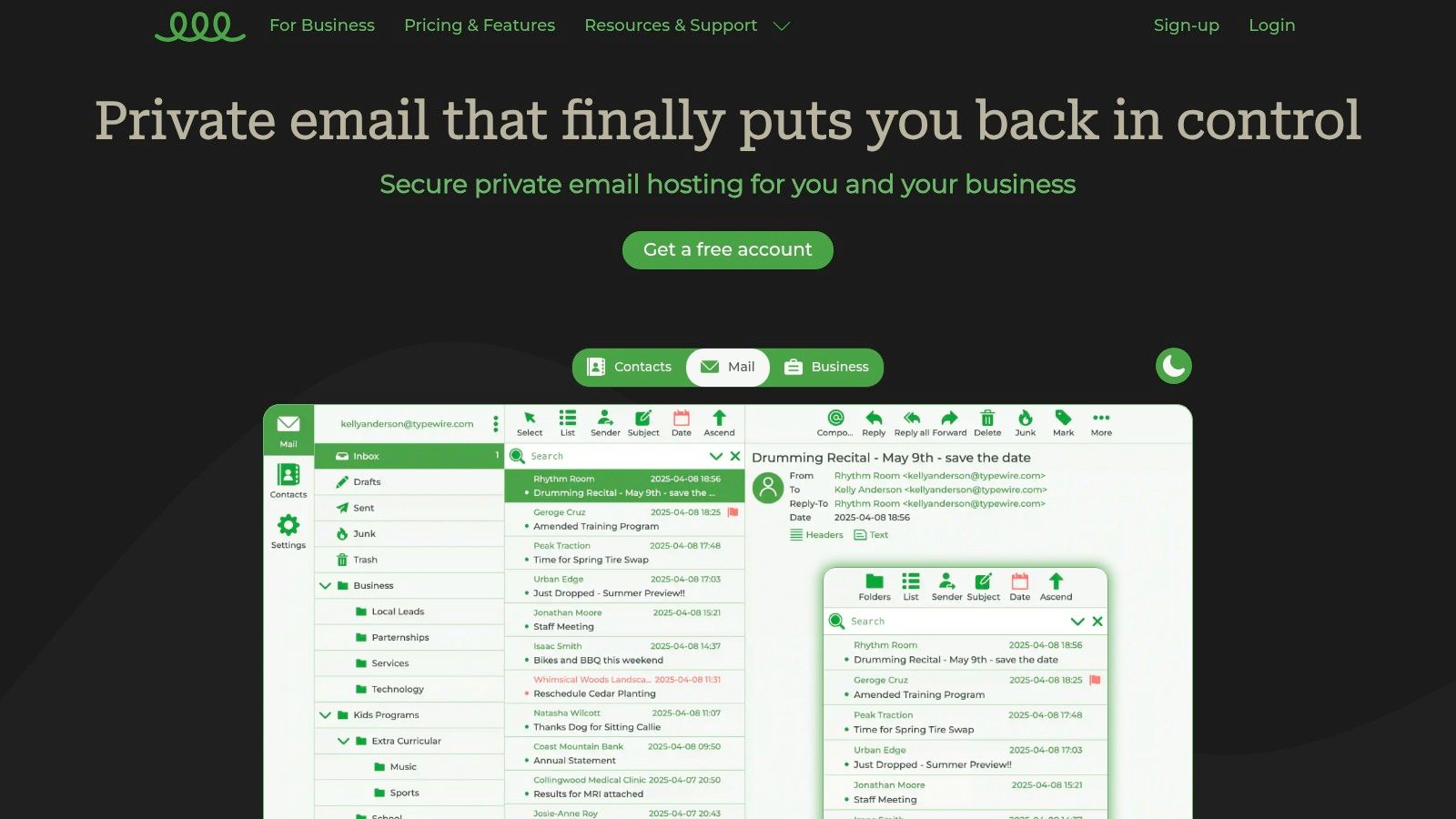
Typewire is the choice for Canadians seeking a ProtonMail-style private email experience governed by Canadian law. Unlike most privacy-focused providers that rely on Swiss or German infrastructure, Typewire operates on its own privately owned and managed data centres in Vancouver, BC, meaning your data is physically in Canada, governed by PIPEDA, and outside the reach of foreign data requests.
The business model is subscription-based, so you won’t get any ads, tracking pixels, or be subjected to data mining. That alignment between how the company makes money and how it treats your data is the gold standard.
Key Features and Strengths
Typewire’s feature set is designed to provide a secure, clean, and efficient communication experience. The service excels in several key areas that set it apart.
- Complete data sovereignty under Canadian law (PIPEDA)
- Custom domain hosting for businesses
- Clean, modern interface with light and dark modes
- Advanced anti-spam and anti-virus filtering
- Easy migration tools from Gmail and Outlook
- Mobile apps for iOS and Android
The Trade-Offs
The primary trade-off is that its private infrastructure, while a major security benefit, may not offer the same hyperscalability as a global cloud provider for massive enterprise clients. However, for its target audience, Typewire’s focused approach to privacy, security, and user experience makes it a top-tier choice.
Pricing and Plan Breakdown
| Plan | Price (monthly) | Storage | Key Features |
|---|---|---|---|
| Starter | CA$1.00/mo | 500 MB | 1 user; 1 @typewire address; 50 emails/day; basic privacy & security |
| Basic | CA$6.39/mo (CA$5.75 annual) | 20 GB | 1 user; 5 aliases; 1 custom domain; IMAP/SMTP; iOS & Android apps |
| Family | CA$18.99/mo (CA$17.09 annual) | 20 GB/user | 6 users included; 5 aliases/user; 1 custom domain; calendar |
| Premium | CA$9.89/user/mo (CA$8.90 annual) | 50 GB/user | Unlimited users; 50 aliases; 5 custom domains; user management; calendar |
All plans include a free 7-day trial and an ad-free, no-tracking experience. Save up to 20% by choosing a 24 or 36-month term.
Practical Use and Getting Started
Getting started with Typewire is straightforward. For those migrating from providers like Gmail, ProtonMail, or Outlook, Typewire provides easy-to-use migration tools to transfer existing emails and contacts, minimizing downtime.
For small businesses or teams, the user management dashboard is particularly useful. Administrators can easily add or remove users, manage aliases, and oversee account settings from a centralized location, making it a scalable solution for growing organizations.
Visit Typewire
2. ProtonMail
Jurisdiction: Switzerland
Encryption: End-to-end (PGP)
Free Trial: Yes, 7 days
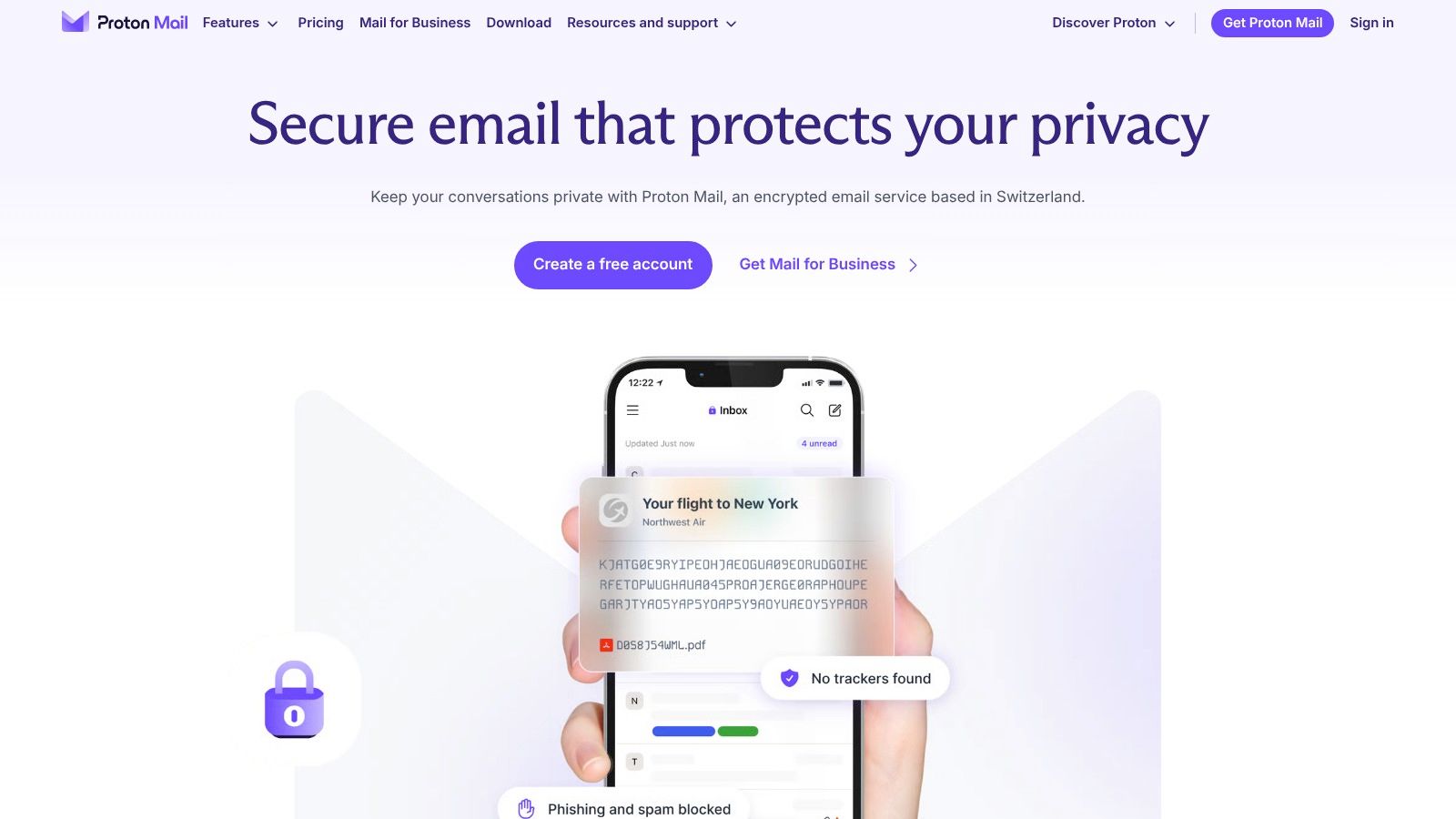
ProtonMail is the benchmark private email provider. It’s the name most people know, and the service Canadians are most often trying to find a local equivalent of. Based in Geneva with some of the world’s strongest privacy laws, it uses end-to-end encryption and a zero-access architecture, meaning ProtonMail staff cannot read your messages.
Paid plans add custom domains, more storage, and access to the broader Proton ecosystem, with VPN, Drive, Calendar, and a password manager.
Key Features and User Experience
- Self-destructing emails with a timer
- Password-protected emails to non-Proton recipients
- Anonymous signup, so no phone number required
- Open-source mobile clients, independently audited
The Trade-Offs
- Does not encrypt subject lines, which is a meaningful gap most people overlook
- Uses Google’s Firebase Cloud Messaging on Android, meaning Google learns when you receive messages, from what IP, and at what times, even if it can’t read the content. For a product built to escape Google’s reach, this is a notable contradiction
- No native desktop clients; the paid “Bridge” for third-party clients stores data unencrypted locally
- Free plan is restrictive; paid plans are among the more expensive here
Pricing and Plan Breakdown
| Plan | Price | Storage | Key Features |
|---|---|---|---|
| Free | Free | 1 GB | Basic personal use; daily send limits; no custom domains |
| Mail Plus | $4.99/mo | 15 GB | 1 custom domain, 10 aliases |
| Proton Unlimited | $12.49/mo | 500 GB | VPN, Drive, Calendar & Pass included; unlimited aliases |
Website: https://proton.me/mail
3. Tuta (formerly Tutanota)
Jurisdiction: Germany (GDPR)
Encryption: End-to-end, including subject lines
Free Trial: Yes, 7 days
Tuta goes further than any competitor on encryption. It encrypts subject lines, attachments, contacts, and calendar entries, not just the email body. It’s also the only major provider actively building post-quantum encryption, a hybrid protocol that will protect stored data from future quantum computing attacks.
Fully open source since launch, and built with zero Google integrations, including its own proprietary push notification system for Android rather than relying on Google’s.
Key Features and User Experience
- Encrypts more data than any competitor, including subject lines
- Quantum-resistant hybrid encryption in development
- Fully open source, independently auditable
- Zero Google integrations on any platform
- No IP logging; anonymous signup without a phone number
- Apps for Android, iOS, Windows, macOS, Linux
- Free plan: 1 GB; paid from €3/month
The Trade-Offs
- No IMAP/POP3 support (by design, it would break the encryption model)
- No cloud storage or enterprise integrations
- Not Canadian
Pricing and Plan Breakdown
| Plan | Price | Storage | Key Features |
|---|---|---|---|
| Free | Free | 1 GB | Full encryption suite including subject lines |
| Revolutionary | €3.60/mo | 20 GB | Custom domain, unlimited aliases, offline mode, encrypted search |
| Legend | €9.60/mo | 500 GB | Priority support; suited to power users and small teams |
Website: https://tutanota.com
4. Hushmail
Jurisdiction: Canada
Encryption: OpenPGP
Free Plan: No
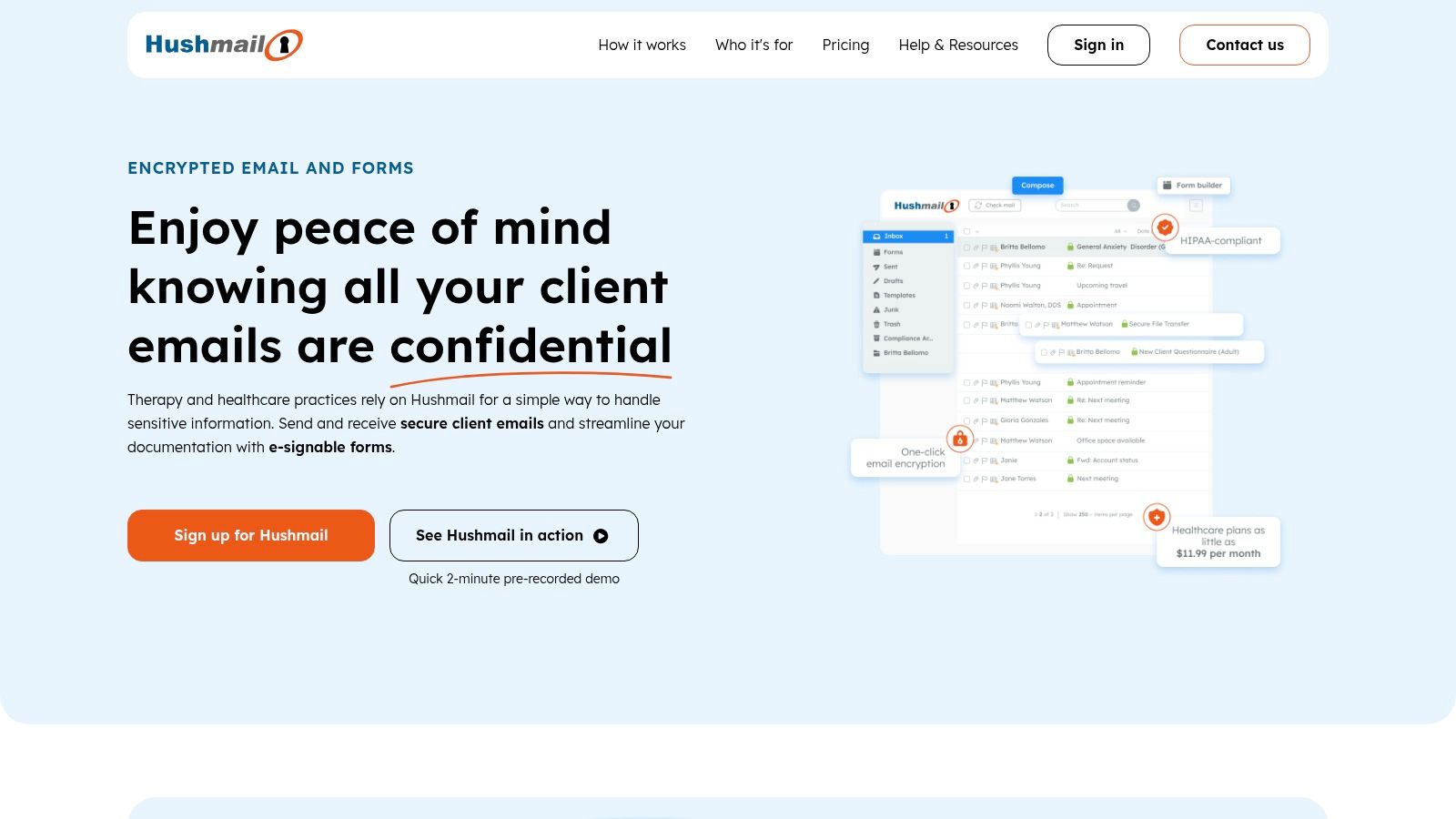
Operating out of Vancouver since 1999, Hushmail has built its reputation in a specific niche: HIPAA-compliant email for healthcare providers, therapists, and legal professionals. If you need a signed Business Associate Agreement (BAA) and compliant communications workflows, it’s purpose-built for you. Secure web forms and built-in electronic signatures make it useful beyond just email.
Key Features and User Experience
- HIPAA-compliant plans with a signed BAA
- Encrypted web forms for securely collecting client or patient information
- Built-in electronic signatures for document workflows
- Custom domain support on all paid plans
- Long operating history and established reputation in regulated industries
The Trade-Offs
- No free plan
- Subject lines are not encrypted; encryption standards lag behind Tuta and ProtonMail
- Pricing and feature set are oriented toward professional compliance, less suited for general personal or everyday business use
Pricing and Plan Breakdown
| Plan | Price | Storage | Key Features |
|---|---|---|---|
| Healthcare Basic | $16.99/mo | 10 GB | encrypted emails, HIPPA-compliant email, BAA included |
| Healthcare Essentials | $20.99/mo | 15 GB | Email templates and scheduling, 3 HIPPA-compliant forms |
| Healthcare Growth | $47.99/mo | 15 GB | full compliance suite, e-signatures, 25 HIPPA forms |
Website: https://hushmail.com
5. Mailfence
Jurisdiction: Belgium (GDPR)
Encryption: OpenPGP
Free Plan: Yes (500 MB)
Mailfence bundles email with a calendar, contacts, document storage, and secure collaboration tools, making it the best option for users who want a full de-Googled productivity suite. Belgian law requires all disclosure requests to go through a court, adding a meaningful legal layer of protection.
Key Features and User Experience
- Full productivity suite: email, calendar, contacts, and encrypted document storage
- Digital signatures for proving message authenticity
- Two-factor authentication (TOTP)
- Custom domain support on paid plans
- Free plan: 500 MB email + 500 MB file storage
The Trade-Offs:
- Logs IP addresses, which is a meaningful gap compared to Tuta or ProtonMail
- Not open source, so code cannot be independently audited
- Subject lines are not encrypted
- The Android app has low adoption, suggesting the mobile experience lags the web interface
Pricing and Plan Breakdown
| Plan | Price | Storage | Key Features |
|---|---|---|---|
| Free | Free | 500 MB email + 500 MB files | Calendar, contacts, document storage |
| Base | $2.50/mo | 5 GB email + 6 GB files | Encryption, 10 aliases |
| Entry | $73.50/mo | 40 GB email | 2 Custom domain, 50 aliases |
Website: https://mailfence.com
6. Posteo
Jurisdiction: Germany (GDPR)
Encryption: OpenPGP (optional)
Free Plan: No
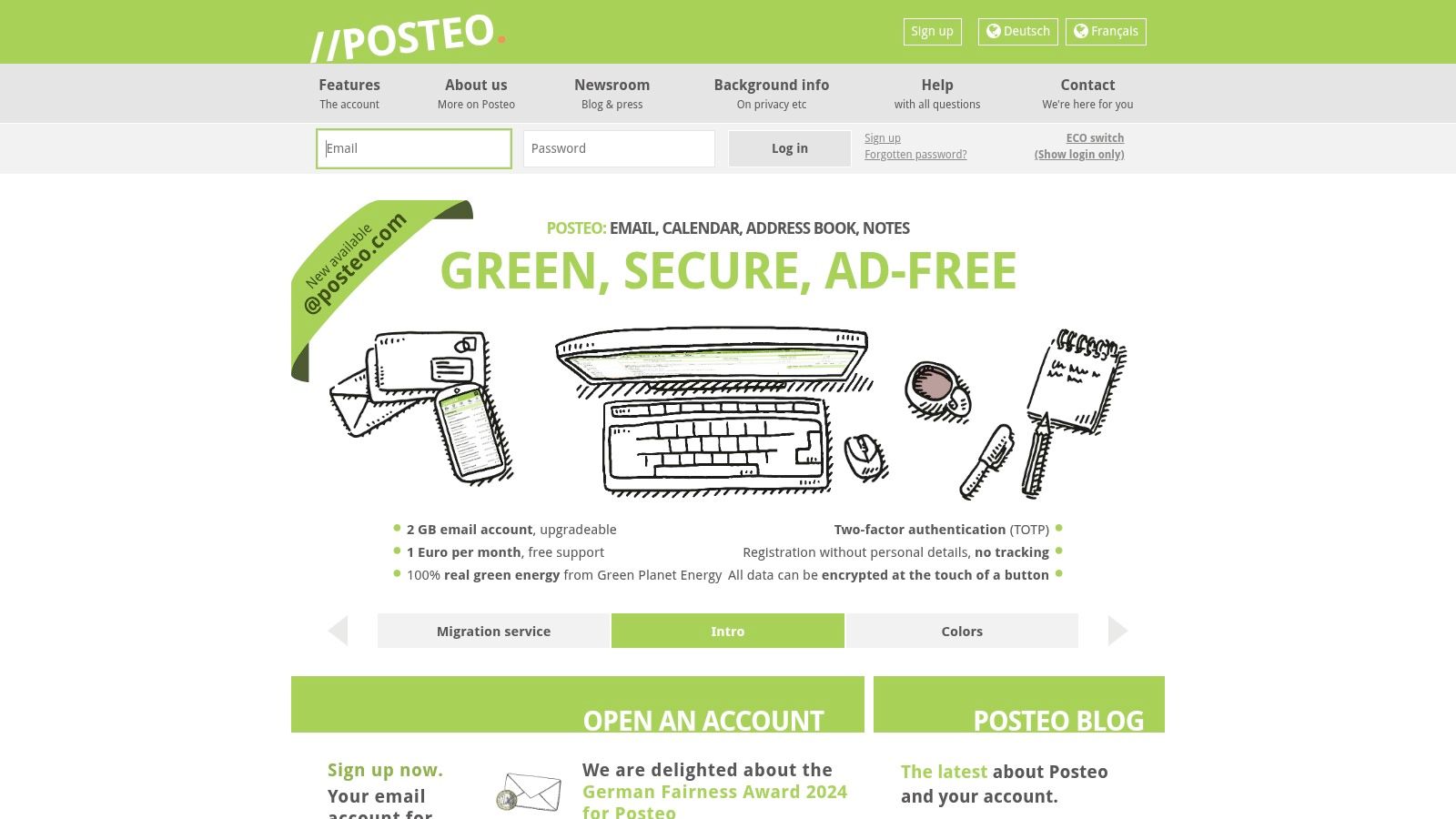
Posteo distinguishes itself through radical anonymity and genuine sustainability. You can sign up with no personal information, and pay with cash sent by mail, meaning Posteo literally cannot link your payment to your account. At €1 per month for 2 GB of storage, it’s the most affordable option in this roundup, and it runs entirely on renewable energy from Greenpeace Energy.
Key Features and Strengths
- Anonymous signup and fully decoupled anonymous payment (cash, bank transfer)
- Full mailbox encryption at rest
- IMAP/POP3 support for use with third-party email clients
- Two-factor authentication
- Green energy operations
The Trade-Offs
- Emails are not automatically end-to-end encrypted. OpenPGP is available but requires manual setup, making it less accessible for non-technical users
- No custom domain support (deliberate, to preserve anonymity — but a hard limit for businesses or professionals)
- 2 GB base storage
Pricing and Plan Breakdown
| Plan | Price | Storage | Key Features |
|---|---|---|---|
| Single Plan | €1/mo | 2 GB | Calendar, address book, IMAP/POP3; extra storage €0.25/GB/mo |
Website: https://posteo.de
7. StartMail
Jurisdiction: Netherlands
Encryption: PGP (one-click)
Free Plan: No
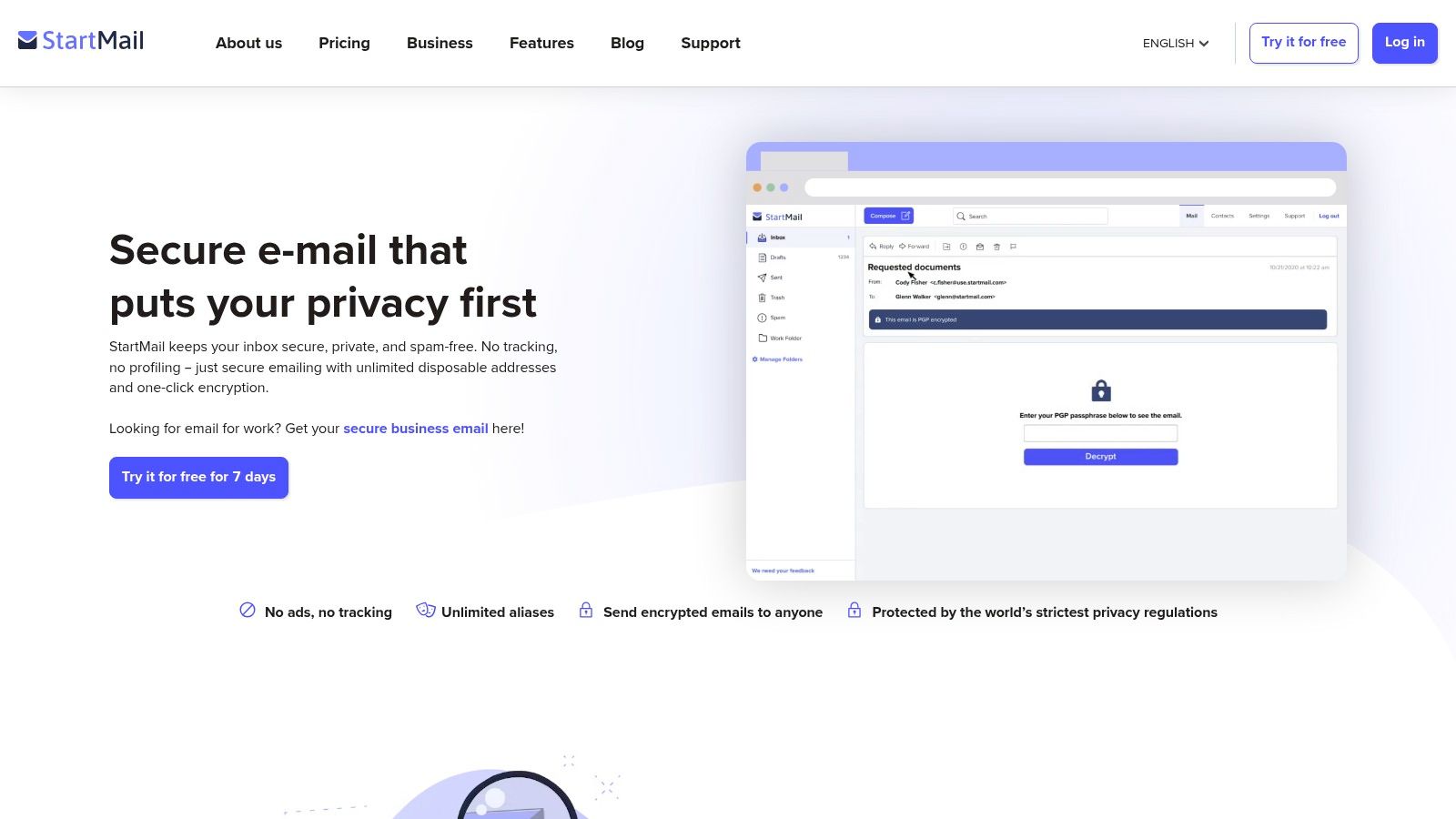
From the team behind Startpage, StartMail’s headline feature is unlimited disposable email aliases, i.e, temporary addresses you can create on the fly when signing up for any service, then discard when the spam starts. PGP encryption is available via a single-click toggle, removing the usual technical friction associated with PGP setup.
Key Features and Strengths
- Unlimited disposable aliases. The most generous implementation of this feature available
- One-click PGP encryption for outgoing messages
- Password-protected emails to any recipient, regardless of their provider
- No ads, no tracking
- 10 GB storage on the personal plan
- Custom domain support on higher plans
The Trade-Offs:
- No free plan. A 7-day trial only
- Not open source
- Smaller brand footprint than Proton or Tuta. This matters if ecosystem trust is part of your decision
- Custom domain requires the more expensive plan tier
Pricing and Plan Breakdown
| Plan | Price | Storage | Key Features |
|---|---|---|---|
| Personal | $6.99/mo | 20 GB | Unlimited disposable aliases, one custom domain |
| Business | $8.99/mo | 30 GB | Custom domain; unlimited aliases, 25% off additional accounts |
Website: https://startmail.com
Privacy Features Comparison of Top 7 Email Services
| Provider | Jurisdiction | Five Eyes? | Subject Line Encrypted | Open Source | Free Plan | Canadian Data? |
|---|---|---|---|---|---|---|
| Typewire | Canada | ⚠ Yes | No | No | Trial (7d) | ✓ Yes |
| ProtonMail | Switzerland | No | ✗ No | Partial | ✓ 1 GB | ✗ No |
| Tuta | Germany | No | ✓ Yes | ✓ Full | ✓ 1 GB | ✗ No |
| Hushmail | Canada | ⚠ Yes | No | No | ✗ No | ✓ Yes |
| Mailfence | Belgium | No | ✗ No | ✗ No | ✓ 500 MB | ✗ No |
| Posteo | Germany | No | No (optional) | No | ✗ No | ✗ No |
| StartMail | Netherlands | No | No | No | Trial (7d) | ✗ No |
Which Provider Should You Choose?
Canadian and want Canadian data residency: Typewire is your ProtonMail equivalent, with data in Vancouver under PIPEDA. For healthcare or law, Hushmail is the right fit.
Want the most advanced encryption: Tuta – subject lines, contacts, calendar, and post-quantum readiness. Nothing else comes close.
Want the most established name: ProtonMail. Swiss jurisdiction and a proven track record. But go in aware of the subject line gap and Google push dependency.
Want the cheapest option: Posteo at €1/month, though end-to-end encryption requires manual setup.
Need disposable aliases: StartMail’s unlimited alias system is the best implementation of this feature available.
Want a full productivity suite: Mailfence, if you’re replacing Google Workspace entirely.
How to Make the Switch
- Define your threat model. Ad profiling, corporate data harvesting, and government surveillance all call for different priorities.
- Start a trial. Typewire and StartMail both offer 7-day trials. ProtonMail and Tuta have free plans. Test before committing.
- Migrate your data. Most providers include migration tools for Gmail and Outlook. Typewire’s support team can guide you through it.
- Update your contacts. Set up a forwarding rule from your old inbox while you transition.
Choosing a private email provider is more than a technical decision; it’s a statement about the value you place on your personal information. By opting for a service that respects your data, you are actively participating in building a more private and secure internet for everyone.
Ready to experience a service that combines state-of-the-art security with a transparent, user-first philosophy? Typewire is built from the ground up on privately owned Canadian infrastructure, ensuring your data remains sovereign and secure.
Explore Typewire’s plans today and take the definitive step toward owning your digital privacy.