Author: williamwhite

  • What is ssl mail? A Clear Guide to How Email Encryption Shields Your Inbox

    What is ssl mail? A Clear Guide to How Email Encryption Shields Your Inbox

    When you hear the term "SSL mail," what should come to mind is one thing: email security. It’s the difference between sending your private thoughts on a postcard for anyone to read, versus sealing them in a letter and sending them via an armoured truck.

    SSL mail is all about making sure no one can snoop on your messages as they travel across the internet. It is a fundamental component of email privacy and a non-negotiable feature of any secure hosted email platform.

    What Is SSL Mail and How Does It Protect You?

    A hand holds an encrypted email envelope with a lock icon, an armored truck on the road.

    If you send an email without any encryption, you’re sending it in plain text. Everything from your login details to the actual message is wide open, creating a massive email security risk. This makes it alarmingly easy for hackers, internet providers, or other prying eyes to intercept and read your private communications. This is exactly why SSL mail is such a crucial first line of defence for your email privacy.

    The technology behind it, Secure Sockets Layer (SSL), creates a secure, encrypted tunnel between your email client (like Outlook or Apple Mail) and the email server. This tunnel prevents anyone from eavesdropping on your communication while it's in transit.

    Imagine trying to have a private conversation by shouting across a crowded room—that’s standard, unencrypted email. Now, picture stepping into a private, soundproof booth where only you and the person you're talking to can hear. That’s SSL mail, a cornerstone of email security.

    The Modern Standard: TLS

    Here's a little secret: while everyone still says "SSL mail," the technology we actually use today is more modern and secure. It’s called TLS (Transport Layer Security).

    The original SSL protocol has known security holes and is now considered obsolete. TLS is its direct successor, but the old "SSL" name just stuck around. So, when you’re setting up "SSL mail" today, you're almost certainly using the much stronger TLS protocol.

    This encryption is what secures the core protocols that make email work. To help you see how this fits together, here’s a quick reference table showing the standard email protocols and their secure, encrypted counterparts.


    Email Protocols and Their Secure Versions

    This table breaks down the common protocols for sending and receiving email, showing you the difference between their standard (insecure) ports and the secure ports that use SSL/TLS encryption.

    Protocol Standard Port (Insecure) Secure Port (SSL/TLS) Purpose
    SMTP 25, 587 (unencrypted) 465 Sending email from your client to a server.
    IMAP 143 993 Retrieving email from a server to your client.
    POP3 110 995 Downloading email from a server to a client.

    Using the secure ports ensures that your connection is encrypted, protecting your data and email privacy from interception as it travels across the internet.


    By wrapping these protocols—IMAP, POP3, and SMTP—in a layer of TLS encryption, your email platform protects every message the moment you hit send. This foundational security is vital, and you can learn more about how these secure email protocols are essential for email security in our detailed guide.

    In Canada, government bodies and security experts recognise this as a fundamental best practice. The Government of Canada, for instance, notes that its own websites use this type of encryption to create a secure connection, making it a widely available standard for protecting data in transit. You can find more details in their guide to email security best practices from the Government of Canada.

    How the SSL and TLS Handshake Secures Your Connection

    So, what's the secret sauce that makes what is SSL mail actually secure? It all comes down to something called the SSL/TLS handshake. Think of it as a complex, secret greeting that your email app and the mail server perform in the blink of an eye. This isn't just a simple "hello"; it's a rapid-fire negotiation to set up a completely private communication channel, forming the bedrock of email security.

    Before a single word of your email travels across the internet, this handshake accomplishes two critical goals. First, it proves the server you're connecting to is the real deal and not some imposter trying to snoop on your messages. Second, it lets your app and the server jointly create a one-time-use secret code—a "session key"—to scramble all the data for that specific connection, safeguarding your email privacy.

    The Handshake: A Secret Digital Greeting

    This entire back-and-forth is designed to build trust before any of your personal information is exchanged. It all happens in a few key steps.

    • Client Hello: Your email client kicks things off. It sends a "hello" message to the server, listing the types of encryption it can handle (these are called cipher suites).
    • Server Hello & Certificate: The server replies, "hello back," and picks the strongest encryption method they both support. Crucially, it then presents its SSL certificate—its official, verified ID.
    • Verification: Your email client acts like a detective, examining the certificate. It checks that the certificate is valid and was issued by a trusted authority, not forged. This step is what shuts down "man-in-the-middle" attacks, a major threat to email security.
    • Creating the Secret Key: With identities confirmed, the client and server use some clever cryptographic footwork to generate a unique, temporary secret key. This is the key that will encrypt and decrypt your email data for the rest of the session.

    If you're curious about the technical magic behind creating that key, our article on symmetric and asymmetric key encryption in email breaks down the underlying principles.

    Upgrading to a Secure Connection with STARTTLS

    What if a connection doesn't start out secure? In some cases, your email app might first connect to a standard, unencrypted port. This is where a command called STARTTLS comes into play. It essentially asks the server, "Hey, can we make this conversation private?"

    If the server agrees, the STARTTLS command triggers the exact same TLS handshake we just walked through. In an instant, the open connection is "upgraded" into a fully encrypted one. You get the same robust security without having to connect to a different, dedicated secure port from the very beginning.

    The bottom line is that this handshake process is the foundation of your email security. It's what guarantees you're talking to the right server and creates the unbreakable code that shields your private communications from prying eyes.

    This is also why older versions of SSL are no longer safe to use. Modern standards like TLS 1.2 and 1.3 use far more powerful encryption. A quality, privacy-focused hosted email platform will enforce these latest TLS standards by default, making sure every single handshake is as strong as it can possibly be.

    The Real-World Threats SSL Mail Defends Against

    So, we've talked about the mechanics of SSL mail, but why is it so critical for your email security? The short answer is that it tackles some very real and common threats head-on. It’s what turns your email from an open postcard that anyone can read into a securely sealed, private letter.

    The most classic and dangerous threat it neutralizes is the man-in-the-middle (MITM) attack.

    Picture this: you're at a local coffee shop, connected to the public Wi-Fi and about to send a sensitive business proposal. A hacker on that same network can quietly place themselves between your laptop and the router. From there, they can intercept every bit of data you send—including your email password and the entire contents of your message.

    Without SSL/TLS encryption, your data is an open book. But with it, all the attacker sees is a jumble of scrambled, meaningless text. That encryption forms a protective tunnel, making your private information completely useless to anyone snooping around and upholding your email privacy.

    Guarding Against Data Mining and Surveillance

    Hackers aren't the only ones interested in your emails. Another, more widespread email privacy threat often comes from the email providers themselves. Many "free" email services fund their business by scanning your messages for keywords to build a detailed advertising profile on you. Every email you send or receive gets catalogued and analyzed.

    This is where choosing a secure, privacy-focused hosted email platform really shines. By simply enforcing SSL/TLS for all connections, they create a fundamental layer of email security against outside snoops.

    When your provider also commits to a zero-data-mining policy, you get the best of both worlds. The SSL/TLS tunnel protects your email from outside interception, while the provider’s privacy policy protects it from internal surveillance, ensuring true email privacy.

    This whole process kicks off with a simple but critical "handshake" between your email client and the server.

    A flowchart showing the SSL/TLS handshake process: Client Hello, Server Hello, and Shared Secret.

    This handshake is the crucial first step. It makes sure a secure channel is established before any of your actual data starts flowing.

    Ensuring Compliance and Confidentiality

    For businesses and even individuals in Canada, keeping email confidential isn't just good practice—it's often a legal requirement under privacy laws like PIPEDA. Using a hosted email platform that mandates modern SSL/TLS encryption is a huge step toward meeting those standards. This is more important than ever, with Statistics Canada reporting that 70% of Canadians experienced at least one cybersecurity incident in 2022.

    The Canadian Centre for Cyber Security explicitly warns that older versions of SSL are no longer secure, stressing the need for the latest TLS protocols to protect sensitive information. A provider like Typewire builds on this foundation, combining mandatory TLS with end-to-end encryption options and Vancouver-based data residency to ensure your messages stay confidential. You can read more on these email security best practices from the Government of Canada.

    Ultimately, SSL mail is about peace of mind. It ensures your personal chats, business deals, and financial information remain exactly as they should be: private.

    How to Check and Enable SSL or TLS on Your Devices

    A laptop on a wooden desk displaying a web interface with 'USE SSL/TLS' and 'Enable SSL' options for secure connections.

    Taking control of your email privacy really comes down to making sure your devices are set up correctly. It might sound technical, but checking that you're using SSL mail is usually just a matter of digging into the settings of your email app, whether that's Outlook, Apple Mail, or Thunderbird.

    Most modern email clients automatically detect and apply the most secure settings for you. Still, it’s always a good idea to double-check their work to ensure your email security is properly configured. You’ll need to find your email account’s server settings, which are often buried in a menu labelled "Advanced" or "Server Settings."

    Finding Your Server Settings

    Once you’re in there, you're looking for the settings for your incoming (IMAP or POP3) and outgoing (SMTP) mail servers. Your goal is to confirm that SSL/TLS is enabled and that you’re using the right port numbers for a secure connection.

    For instance, a secure IMAP connection should always use port 993 with SSL/TLS turned on. For your outgoing mail, a secure SMTP server will use port 465 (with SSL/TLS) or 587 (with STARTTLS). If you spot insecure ports like 143 (IMAP) or 25 (SMTP) being used without any encryption, your connection is wide open.

    Think of it this way: verifying your settings is like making sure the armoured truck is actually locked before it drives off. If SSL/TLS is disabled, you’re sending all your private information—including your password—in the clear, creating a massive email security vulnerability.

    Of course, things can sometimes go wrong during setup. If you run into trouble, knowing how to troubleshoot 'cannot connect using SSL' errors can save you a lot of headache by helping you figure out what's causing the issue.

    The Advantage of Secure-First Providers

    This whole setup process is where privacy-focused hosted email platforms really shine. Instead of making you hunt for the right settings, providers like Typewire give you crystal-clear, step-by-step guides with the exact information you need for any device.

    Because they build their platforms with email security and email privacy as core principles, their services are secure by default. They configure their servers to only accept encrypted connections, making it almost impossible for you to set up your email client insecurely by accident. It's a simple, effective approach that makes top-tier privacy accessible to everyone, not just the tech experts.

    Why Your Hosted Email Platform Is Key to Security

    While setting up your email client correctly is important, the real foundation of your email security lies with your provider. Think of it this way: you can install the best lock money can buy on your apartment door, but it won't matter much if the building itself has flimsy walls and no front-desk security.

    Your hosted email platform is that building. Its core architecture and privacy policies determine just how secure your communications can ever be.

    That’s why your choice of provider is so critical if you're serious about email privacy. When a service runs its entire operation on a massive public cloud (like Amazon AWS or Google Cloud), your data is ultimately governed by that third party's policies and exposed to its vulnerabilities. On the other hand, a provider that owns and operates its own hardware on private infrastructure gives you a completely different level of security.

    The Power of a Private Infrastructure

    When an email provider owns its servers, network, and data centre, it can make a simple but powerful promise: your data never leaves its ecosystem. This isn't just about better performance; it's about building a digital fortress around your information.

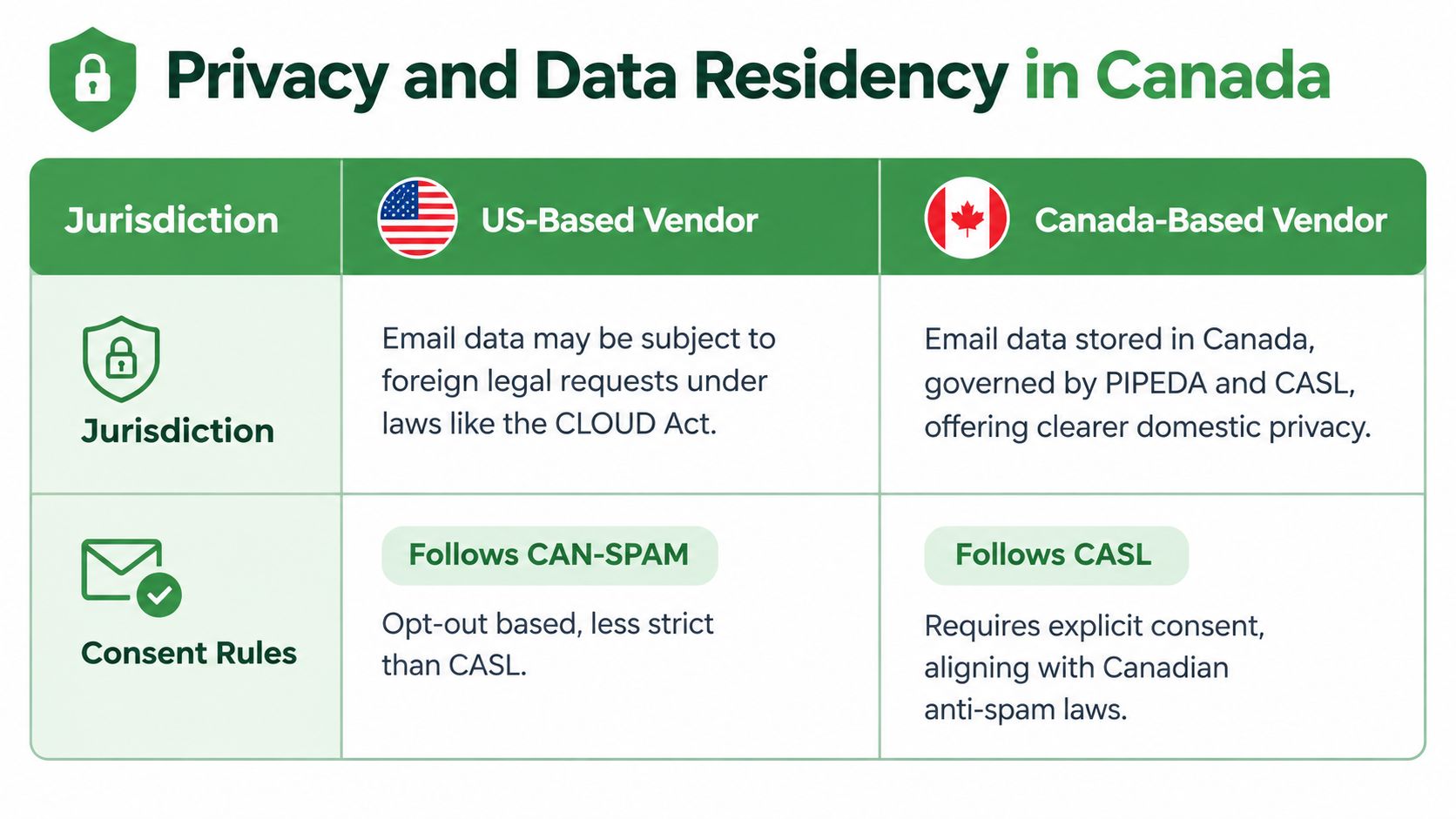
    For example, a service like Typewire, which runs on its own private hardware stack in Vancouver, ensures your data stays protected under Canadian privacy laws like PIPEDA. This independence means your emails aren't being routed through or stored in countries with weaker privacy standards. You get genuine data sovereignty and stronger email security.

    Your choice of a hosted email platform is the single most important decision for your email security. When a provider controls its own infrastructure in a privacy-friendly jurisdiction, security is built-in from the ground up, not just added on top of someone else's cloud.

    This control touches every aspect of security. We know that robust SSL/TLS is non-negotiable, especially when 7.4% of Canadian firms report a lack of resources as a barrier to improving their cybersecurity. As detailed in StatCan's data privacy analysis, having a provider that handles the heavy lifting is essential. By owning its infrastructure, a service can enforce mandatory SSL/TLS encryption across the board, securing every message without you having to second-guess the settings.

    An Integrated Security Ecosystem

    A truly secure hosted email platform offers more than just encrypted connections; it delivers an entire ecosystem designed to protect you from modern threats. This creates multiple layers of defence for your email privacy.

    A privacy-first platform typically bundles these protections together:

    • Mandatory SSL/TLS Encryption: All connections—incoming and outgoing—are encrypted by default. This eliminates the risk of misconfiguration and ensures no email ever travels in the clear.
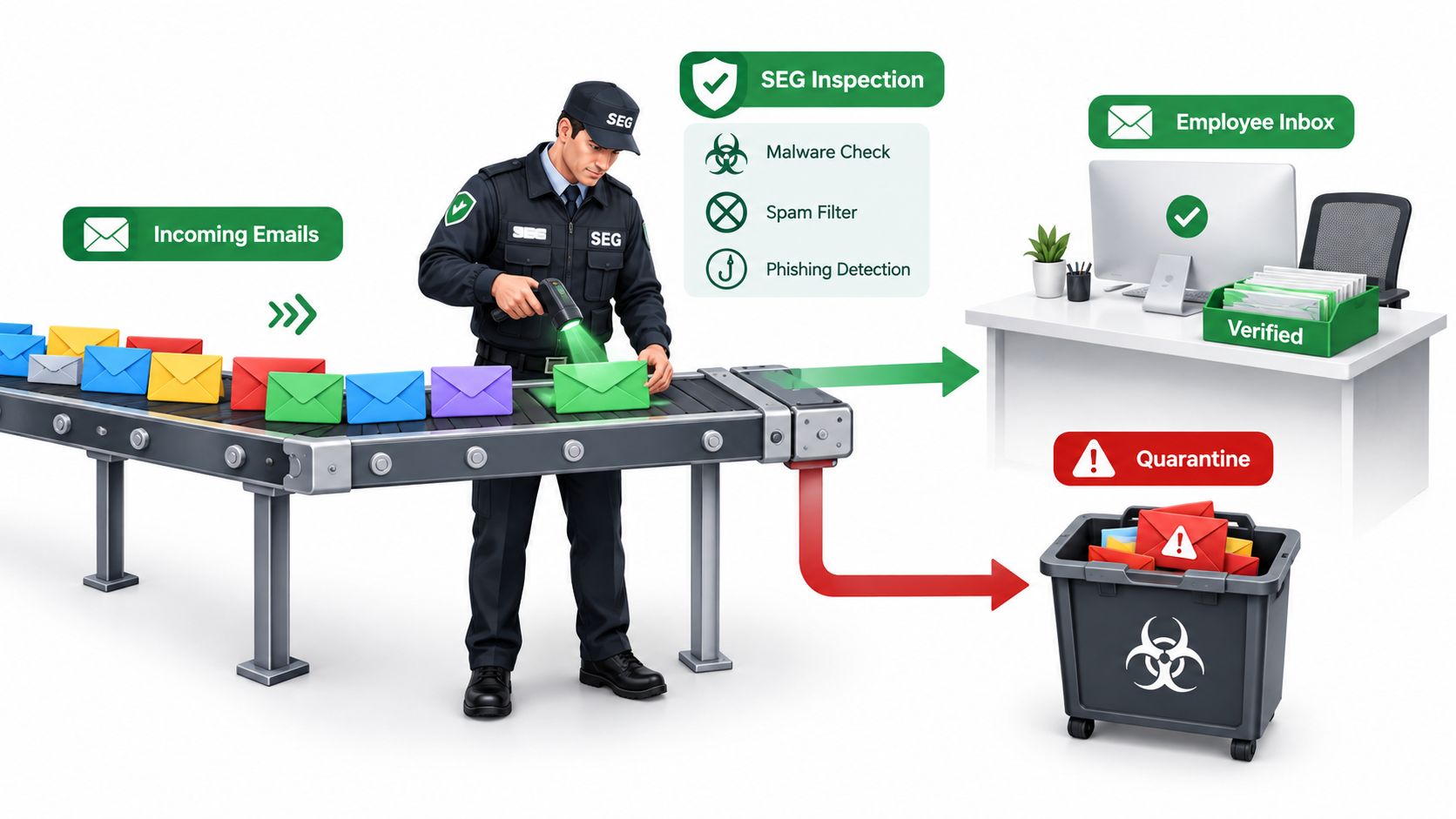
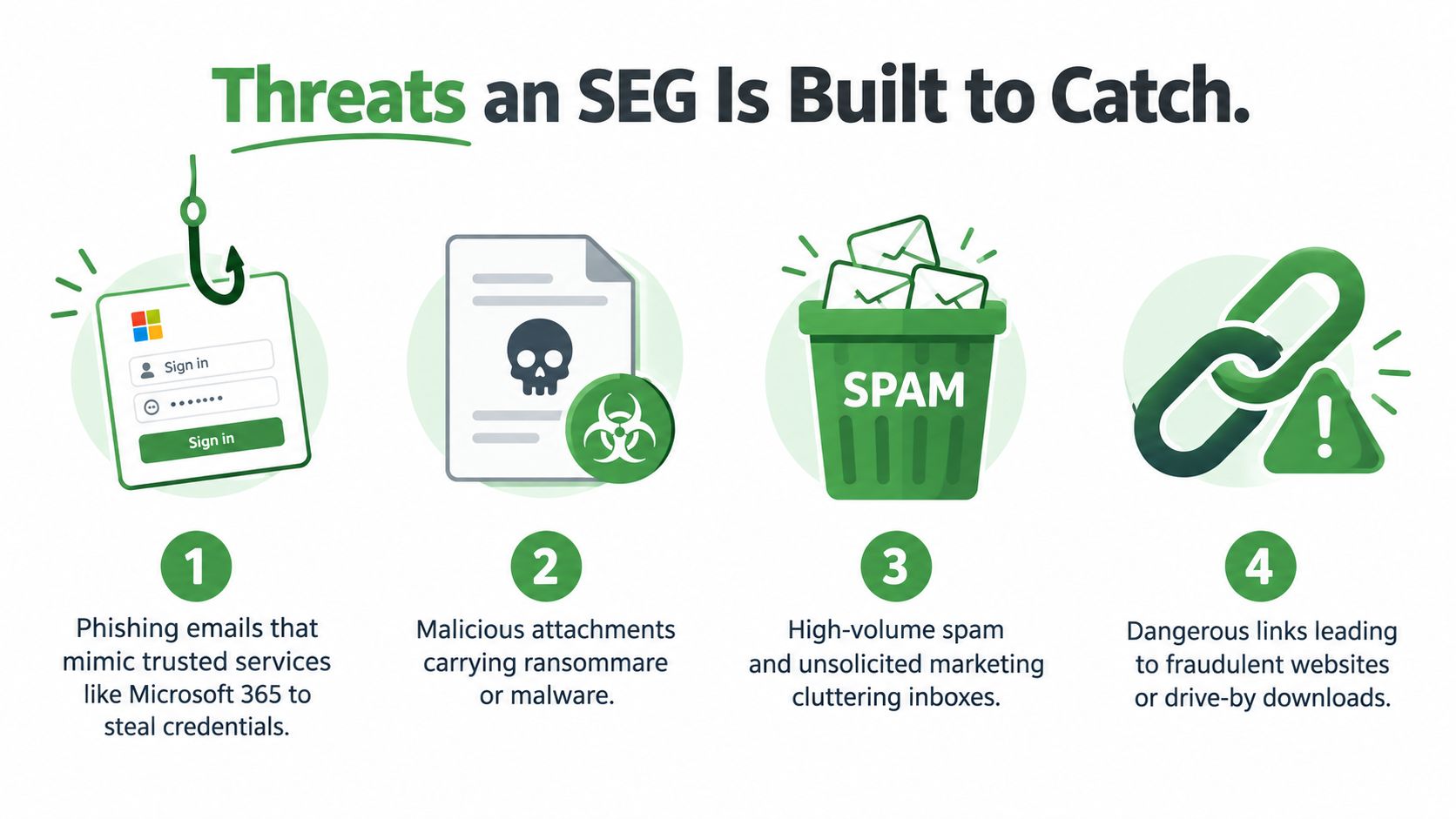
    • Advanced Threat Filtering: Smart, automated systems scan for and block spam, viruses, and phishing schemes before they have a chance to land in your inbox.
    • Automatic Tracker Blocking: Hidden spy pixels and other tracking methods embedded in marketing emails are stripped out automatically, preventing senders from knowing when or where you opened their message.

    By integrating these features, a provider shifts the security burden off your shoulders. You don't have to be a tech expert to stay safe. If you want to dig deeper into what makes a provider truly secure, our guide to secure email hosting breaks down exactly what to look for.

    Common Questions About SSL Mail and Email Privacy

    Once you start looking into what is SSL mail, a few common questions always seem to surface. Getting clear on the answers is key to really understanding modern email security and what genuine email privacy looks like.

    Let's walk through some of the most frequent sticking points, starting with the biggest one: the confusion between securing the connection and securing the message itself.

    Is SSL Mail the Same as End-to-End Encryption?

    That's a great question, and the answer is no—but they are both critical pieces of the email security puzzle.

    Think of SSL/TLS as the armoured truck that moves your mail between post offices. It encrypts the connection between your email client and the server, making sure no one can spy on your messages while they're in transit.

    End-to-end encryption (E2EE), on the other hand, is like writing your letter in a secret code that only you and your recipient know how to read. The message itself is scrambled, so even your email provider can't peek at the contents.

    Both are essential for truly private communication. SSL mail protects the conversation from being intercepted on its journey, while E2EE protects the content of the message itself, even from the servers handling it. They are two different tools that solve two different email security challenges.

    What Happens If I Don’t Use SSL for My Email?

    Connecting to your email without SSL/TLS is a massive, and frankly, unnecessary risk. Every single thing you send and receive—your login details, your attachments, the full body of every message—travels in plain text.

    It’s the digital version of sending a postcard. Anyone with a foothold on the network can read it all.

    This is especially dangerous on public Wi-Fi at a café, airport, or hotel. A snooper on the same network could easily grab your password and gain complete access to your account. It's one of the biggest and most avoidable holes in email security.

    Thankfully, most reputable hosted email platforms and modern apps make it very difficult to connect without encryption today. Still, it's always worth double-checking that your settings are secure.

    Can I Use SSL Mail with My Own Custom Domain?

    Absolutely! In fact, you should consider it non-negotiable for any professional or business email. Any quality hosted email platform will provide seamless SSL/TLS security for your custom domain right out of the box.

    When you set up an address like your.name@yourbusiness.ca, your provider handles all the heavy lifting. They manage the server-side SSL certificates and then provide you with simple, secure settings to use in your email client.

    This way, you get a professional, branded email address without ever having to compromise on email privacy or security. It’s a huge advantage over trying to run your own mail server, where all that technical work would fall on you.

    Are Free Email Services Secure?

    This is where the conversation about email privacy gets more nuanced. On one hand, yes, most major free email services (like Gmail) use SSL/TLS to encrypt your connection. This gives you a solid baseline of protection against network eavesdropping, which is a great start.

    However, their business model is often built on analyzing your email content to serve you ads and collect data. So, while SSL protects your emails from outside hackers, it doesn't protect them from your provider. For them, your data is the product.

    In contrast, a privacy-focused hosted email platform provides the same robust SSL/TLS protection but operates on a fundamentally different philosophy. Their business is providing a private service, not mining your data. This means a strict no-data-mining policy, ensuring your conversations remain confidential from everyone—a cornerstone of true email privacy.


    Ready to put true privacy at the core of your communications? Typewire offers a secure, Canadian-based email solution built on privately owned infrastructure. With mandatory SSL/TLS, automatic tracker blocking, and a strict no-data-mining promise, your email remains yours alone. Start your 7-day free trial and experience private email today at https://typewire.com.

  • Unsend an email: Preserving Your Privacy and Security

    Unsend an email: Preserving Your Privacy and Security

    We’ve all been there. That heart-stopping moment right after you hit ‘send’ on an email, followed by the immediate, desperate wish for a rewind button. It’s a universal feeling, but it speaks to a deeper issue of email security.

    But here’s the hard truth: trying to unsend an email is often impossible once it leaves your server. While many modern email platforms offer a ‘Recall’ or ‘Undo Send’ feature, what they’re really giving you is a short, pre-set delay before the message actually goes out. True retraction, pulling a message back from someone else’s inbox, is a technical myth that highlights a fundamental lack of control over your data on most hosted email platforms.

    That Oh-No Moment After You Hit Send

    A man with a shocked expression looks at his laptop, an overlay reads 'SENT TOO SOON'.

    In a business context, a simple email mistake can quickly escalate from embarrassing to a serious security and privacy breach. Imagine you accidentally forward a message with a private, critical comment still attached, or you send a spreadsheet with confidential payroll data to the wrong person. These aren’t just hypotheticals; they happen every day, creating security vulnerabilities and privacy violations.

    The simple fact is, once your email is accepted by the recipient’s server, you’ve completely lost control. It’s like trying to take back words you’ve already spoken out loud. This is the core challenge that makes unsending an email so difficult and highlights the inherent security risks in standard email protocols.

    The Real-World Impact of Email Mistakes

    The frantic need to retract a message usually stems from common, high-stakes errors that put private information at risk. These scenarios shine a light on the built-in limitations of standard hosted email services, where you have very little control over your data’s privacy and security once it’s sent.

    Just think about these all-too-common situations:

    • Accidental Recipient: You add a client to an internal email thread where your team is candidly discussing project challenges and budgets.
    • Sensitive Data Leak: You mean to send a report to the finance department, but autocomplete inserts the company-wide “All Staff” distribution list instead.
    • Forwarding Faux Pas: You forward a long email chain without realising a colleague’s sensitive, private comment is buried deep in the reply history.

    Each of these mistakes creates an instant data incident. For Canadian businesses, this can trigger legal obligations under privacy laws like the Personal Information Protection and Electronic Documents Act (PIPEDA), which sets the rules for how private sector organisations must handle personal data.

    The impulse to unsend an email is a direct response to a loss of control. It underscores a critical gap in email security: the moment you hit send, your data’s privacy is no longer in your hands but depends on the architecture of multiple, independent servers.

    The Scope of Accidental Sends

    This isn’t a small or infrequent problem. In the Canadian professional sphere, where privacy is a top priority, a staggering 68% of professionals admit to sending an email they immediately regretted. Often, these mistakes involved leaking sensitive financial data or compromising privacy by adding unintended recipients.

    The costs are just as significant. In 2026 alone, Canadian businesses grappled with 142,000 reported email-related data incidents, costing the economy an estimated $4.7 billion in remediation and lost productivity. You can explore more about the business impact of these email incidents and how leading services are working to address them.

    How to Unsend an Email in Gmail and Outlook

    We’ve all felt that jolt of panic after hitting ‘send’ too soon. While a true, universal “unsend” button is still the stuff of technical dreams, the two biggest email platforms, Gmail and Outlook, have built-in features that try to give you a do-over.

    These tools can be lifesavers, but they’re not magic. They come with some serious limitations you need to understand to manage your email and protect your privacy. Let’s break down how they work—and more importantly, where they fall short in terms of email security.

    Using Gmail’s “Undo Send” Feature

    Gmail’s solution is refreshingly simple. It doesn’t actually recall a sent email. Instead, it just waits a few seconds before sending it at all. Think of it as a built-in-procrastinator that gives you a brief moment to catch a mistake, enhancing your control over your email security.

    Once that little window of time closes, your email is out in the wild. For good.

    Your first move should be to extend this grace period to the maximum. It’s a simple tweak that can make all the difference.

    1. In Gmail, find the gear icon in the top-right corner and click on “See all settings.”
    2. Stay on the “General” tab and look for the “Undo Send” option.
    3. The default is usually a nail-biting 5 seconds. Change this “Send cancellation period” to 30 seconds.

    That 30-second buffer is now your safety net. After you send a message, a small black box pops up in the bottom-left corner of your screen with an “Undo” button. Click it, and the email is instantly pulled back into your drafts folder, having never left Google’s servers.

    The key takeaway here is that this is a proactive security measure, not a reactive one. It works every time because the email isn’t truly sent until the timer runs out. This is a world away from how Outlook handles things.

    The Unreliable Nature of Outlook’s “Recall This Message”

    Microsoft Outlook takes a completely different—and far riskier—approach with its “Recall This Message” feature, especially if you’re using it within a Microsoft 365 or Exchange environment.

    Unlike Gmail’s delay, Outlook actually tries to reach into your recipient’s inbox and claw the message back, either by deleting it or swapping it with a new one. In practice, though, the success rate is notoriously low, creating a false sense of security.

    For a recall to have any chance of working, a whole list of stars must align:

    • Shared Environment: Both you and your recipient must be using Outlook inside the same Microsoft 365 organisation. If you’re sending to an external hosted email platform like Gmail or a private provider, it’s almost guaranteed to fail.
    • Unread Message: The recipient cannot have opened your email. If they’ve already read it (or even if it’s just been marked as ‘read’ by a preview pane), the recall will fail.
    • No Mail Rules: If the recipient has a rule that automatically moves your email from their inbox to another folder, the recall can’t find it and won’t work.
    • Desktop Client: The feature is most reliable when both parties are using the Outlook desktop application. Success on the web or mobile versions is a total toss-up.

    Here’s the real kicker: if the recall fails, Outlook often sends the recipient a second message notifying them that you attempted to recall the first one. This does little more than shine a giant spotlight on your original mistake, compounding the privacy issue.

    These limitations show just how little control we have on mainstream hosted email platforms. For situations that demand more robust security, it’s worth exploring how to send a truly secure email in Gmail to add a much stronger layer of protection.

    Why Most ‘Unsend’ Features Are Built to Fail

    Let’s get one thing straight: you can’t truly unsend an email. Thinking you can is a common and costly misconception about email security.

    Think of it like dropping a letter into a classic red Canada Post mailbox. Once that letter is in the system and on its way, you can’t just reach in and grab it back. You’ve lost control. Email works in a surprisingly similar way, all thanks to a decades-old standard called the Simple Mail Transfer Protocol (SMTP).

    When you hit “send,” your hosted email platform doesn’t deliver it directly. Instead, it hands your message off to a chain of independent servers. The moment the recipient’s server accepts that message, it’s game over. Your control is gone.

    The Point of No Return

    Once your email lands on the recipient’s server, it’s effectively their data, living on a system you have no access to or control over. This is the fundamental reason a true “unsend” is a technical impossibility for most email systems. It’s a huge security and privacy gap that many people don’t realise exists in their hosted email platform.

    The infographic below shows how different platforms try to manage this moment of panic. It’s a stark contrast between a simple delay and a recall attempt that’s almost certain to fail.

    A diagram illustrating the step-by-step process of unsending emails in both Gmail and Outlook.

    As you can see, Gmail’s approach is more of a safety net, while Outlook’s is a desperate last-ditch effort that rarely works in the real world.

    A Tale of Two Illusions

    Mainstream hosted email platforms know we all make mistakes, so they create the illusion of control. But how they do it—and how well it works—couldn’t be more different.

    • Gmail’s Send Delay: Gmail’s “Undo Send” feature isn’t magic. It’s simply a timed delay. It holds onto your email on its own servers for a brief window (up to 30 seconds) before it even begins the delivery process. If you hit undo in time, the email was never actually sent. It’s a clever trick, but it’s just a pause button.
    • Outlook’s Failed Recall: The “Recall This Message” command in Outlook is far more ambitious, which is precisely why it usually fails. It sends a second, automated message to the recipient’s server requesting that the original email be deleted. This only works reliably if both you and your recipient are on the same internal Microsoft Exchange server. If they use a different hosted platform, or have already opened the email, the recall will fail, and they’ll often get a notification that you tried to recall it—making things even more awkward.

    The need for a better solution has become painfully obvious. Between 2020 and 2026, email volume in the Greater Toronto Area alone shot up by 220%. This massive increase in traffic just raises the stakes for email security. We’ve seen the real-world consequences, like the 2021 Rogers Communications breach where unrecallable internal forwards exposed 2.4 million customer emails, leading to a $14 million class-action settlement under PIPEDA. You can learn more about how modern email providers are tackling these challenges to keep users safe.

    The core lesson is clear: true control over your data is lost the moment it leaves your provider’s infrastructure. This fundamental flaw in most hosted email services is why features that try to unsend an email are built to fail from the start.

    Proactive Habits to Prevent Email Mistakes

    Since we’ve established that truly unsending an email is often a roll of the dice, your best defence is simply not making the mistake in the first place. This isn’t about being perfect; it’s about building a few smart habits that act as a safety net, protecting your privacy and email security before you ever have to scramble for the recall button.

    Think of it as developing a more thoughtful, deliberate workflow. When privacy and security are baked into your routine, you’ll find you have far fewer “oops” moments to worry about.

    Slow Down and Double-Check

    The vast majority of email blunders I’ve seen happen for one simple reason: rushing. The single most effective habit you can build is to pause and give your message one final review before it goes out the door. Pay a ridiculous amount of attention to the recipient list.

    A quick scan of the “To,” “Cc,” and especially the “Bcc” fields can prevent a world of pain. This is especially true when you’re about to “Reply All” on a long, winding email thread—it’s incredibly easy to overlook someone who was added along the way. A great rule of thumb is to add recipients last, only after you’ve drafted and proofread the entire message.

    To really polish your message and avoid misinterpretation, you can use tools that help you fix grammar and spelling before sending. A clear, professional email is one you’re less likely to need to retract.

    Use Your Drafts Folder as a Cooling-Off Zone

    Your drafts folder is probably the most underutilised privacy tool you have. For any message that’s important, sensitive, or written with a bit of emotion, write the email and then manually save it as a draft. Walk away. Go get a coffee, or just give it ten minutes.

    When you come back to that draft with a fresh pair of eyes, you’ll be amazed at what you spot—awkward phrasing, a tone that’s a little too sharp, or a factual error you missed in the heat of the moment. This simple pause is your manual “unsend” button, giving you that crucial window for a second thought.

    This habit transforms your drafts folder from a forgotten corner of your inbox into a strategic buffer zone, saving you from sends you’ll almost certainly regret later.

    Create Templates and Aliases for Security

    Improvising is a recipe for disaster when you’re routinely sending emails with sensitive information. Instead of writing these messages from scratch every time, creating pre-approved templates is a game-changer for email security. It dramatically minimises human error and keeps your communication consistent.

    • Templates for Routine Tasks: Build templates for common jobs like sending invoices, sharing weekly reports, or welcoming new clients. This practically eliminates the risk of attaching the wrong person’s financial data or CC’ing the wrong project group.
    • Aliases for Privacy: An email alias is basically a disposable forwarding address that hides your real one. Use aliases when you sign up for newsletters, create online accounts, or post on public forums. It keeps your primary email address clean and out of spammer databases. If an alias ever gets compromised or flooded with junk, you just delete it, protecting your main account’s security.

    Putting these habits into play—slowing down, using drafts, and leaning on templates—will strengthen your email game immensely. If you’re looking for more ways to get on top of your inbox, have a look at our guide on essential tips for email management.

    Gaining Real Control with a Private Email Host

    A man in a blue shirt adjusts equipment inside a green server rack labeled "PRIVATE EMAIL."

    So far, we’ve seen that the ‘unsend’ button on most popular hosted email platforms is more of a hope than a guarantee. It’s a quick fix that often fails. If you’re serious about email security and privacy, the real answer isn’t a better button—it’s a fundamentally different kind of hosted email platform.

    This is where private email providers come in. A service like Typewire, a Canadian company, was built from the ground up to address the privacy and security issues inherent in mass-market email services. It’s not about damage control; it’s about having a secure, self-contained environment from the start.

    An Architecture Built for Privacy

    The crucial difference comes down to who owns the infrastructure and where it’s located. Typewire is hosted on privately owned hardware in Vancouver. This isn’t just a point of pride; it means the service is fully compliant with Canada’s strict privacy laws, including PIPEDA. Your data has data residency in Canada, so your emails aren’t being routed through servers in other countries owned by massive third-party cloud corporations.

    This closed-loop system is what makes features like a ‘send delay’ genuinely reliable. Because Typewire controls the entire server stack, it can promise that a delayed message is held securely on its own Canadian servers before it’s sent. There are no outside hosted platforms or third-party servers that could complicate or block a recall.

    When your email provider owns its own infrastructure and operates under strong national privacy laws, you gain genuine authority over your communications. The ability to reliably pause or manage an outgoing email is a natural outcome of a system designed for security, not data harvesting.

    Moving Beyond Unsend to Proactive Security

    A truly private hosted email platform changes the entire conversation. Instead of just reacting to mistakes, you can start preventing them. The panic that leads us to frantically search for the ‘unsend’ button often comes from security gaps that a well-designed service should already have covered.

    Typewire tackles these head-on with features that protect your email privacy by default:

    • Default Spy Pixel Blocking: Automatically strips those invasive tracking pixels from incoming emails. Senders get no information on when or where you opened their message.
    • True Zero-Access Encryption: Your emails are encrypted so that not even the provider can read them. Your conversations remain completely private.
    • Support for Custom Domains: This lets you build credibility with your own branded email address while keeping everything inside a secure, private system.

    If you’re thinking about making a change, our guide to private email hosting services provides a much deeper dive into what makes these platforms stand out.

    The numbers back up this shift in thinking. Effective unsend features could prevent an estimated 52% of workplace email disputes in Canada. On a larger scale, Canadian businesses lose around $2.1 billion every year to misunderstandings caused by email, and 28% of that is directly tied to messages that couldn’t be fixed after being sent.

    Ultimately, choosing a private email host isn’t just about finding a better ‘unsend’ button. It’s about taking back your digital privacy from Big Tech and gaining real, meaningful control over your most critical communications.

    Common Questions About Unsending Emails and Privacy

    When you’re scrambling to get an email back, a lot of questions pop up. What actually works? What are the security risks? Let’s clear up some of the most common points of confusion around unsending emails and what it all means for your privacy.

    Can Someone Tell If I Recall an Email in Outlook?

    Yes, and it can get awkward. If the original email has already landed in their inbox, the recipient gets a separate, brand-new message telling them you tried to recall the first one.

    Worse, if they’ve already read your original message, it won’t be deleted. The recall attempt just sits there, basically highlighting your mistake. Because it’s so high-risk, focusing on prevention with a secure, private hosted email platform is always a better strategy.

    Does Gmail’s Unsend Feature Work with Other Email Providers?

    It sure does. The trick is that Gmail’s “Undo Send” isn’t a recall function at all—it’s just a simple send delay. It holds your email on Google’s servers for a few seconds before it ever goes out.

    This means you can cancel it before it’s sent, and it works perfectly no matter which hosted email platform the recipient uses.

    This is a world away from Outlook’s “Recall” feature. Outlook actively tries to claw a message back from an external server, a request that almost always fails when sending to an outside account, like from your work email to someone’s personal one.

    Why Is a Private Email Host Better for Managing Email?

    It really comes down to control and trust. A private email host that runs its own infrastructure, like Typewire, gives you genuine sovereignty over your data and bolsters your email security. Because Typewire manages its own servers in Canada under PIPEDA, it can guarantee that a feature like a send delay works flawlessly every single time.

    A private host’s entire business is centred on user email privacy. You won’t find any ad-scanning or data mining. Instead, you get built-in protections like automatic tracker blocking. Your messages are simply more secure from the get-go, which helps soften the blow of any mistake you might make.

    Is It Ever Truly Possible to Unsend an Email?

    In the literal sense, no. Once an email has been delivered to a recipient’s server, you have no technical means to force that server to delete it. Any feature called “unsend” is really just one of two things:

    • A delay mechanism, which cleverly stops the email before it’s truly sent.
    • A recall request, which politely asks the recipient’s server to delete the message—a request that is almost always ignored.

    This technical reality is why choosing a secure and private email provider is so critical. It gives you the control you need right from the start.


    Take back control of your digital privacy and stop worrying about email mistakes. Typewire offers a secure, Canadian-hosted email solution with reliable send delays, default tracker blocking, and zero-access encryption. Try it free for 7 days.